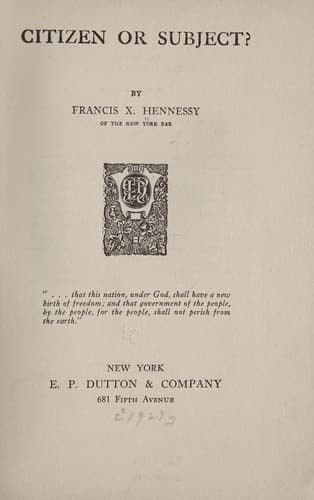
Constitutional history -- United States; United States -- Politics and government; United States. Constitution. 18th Amendment
Our mirth entirely dispels our indignation, when we sense his full
concept of the nature of that absurd Fifth Article “grant” to his
government clients. That we may not mistake his concept, the most Tory
concept ever stated as law in America since 1776, he explains it again
and again in his briefs. It is his concept that the absurd supposed
“grant” gives to his client governments, not one member of which is
ever elected by the citizens of America, unlimited and constitutionally
unrestrained power to interfere with the individual freedom of the
American citizen on every matter or, as the Declaration of ’76 put it,
in its complaint against the English King and _his_ legislature, to
legislate for us on all matters whatsoever.
And our mirth is not lessened when we read, in this brief, John
Marshall’s full statement of the making of the Constitution (with the
Fifth Article in it) and John Marshall’s clear decision that it was all
made by the citizens of America, the “conventions” of the Seventh and
the Fifth Articles.
No statement of facts could ever be written, which more absolutely
destroys the concept that the state governments have the omnipotence
denied to the English Parliament, than the quotation from John Marshall
which we read in this brief to support that concept.
Throughout the quotation, with which _we_ are all very familiar,
Marshall points out that there is a vital distinction, amazingly
important to individual freedom, between the ability of the
“conventions” (named by exactly the same name in the Fifth as well as
the Seventh Article) and the limited ability of the same “legislatures”
for which this counsel appeared in 1920. In the quotation Marshall
points out that, when the American citizens are to make a NATIONAL
Article, like the First Article and the Eighteenth Amendment, there
is but one way in which they can make it “safely, EFFECTIVELY and
wisely,” “by assembling in convention.” That all of us, including
that counsel of 1920, may not find any excuse for an assumption that
state governments can ever make Articles _of that kind_, Marshall
dwells at length upon the _inability_ of state governments or any
governments to make them or any Article like them. He tells us that,
when the _American_ people make Articles _of that kind_, in the only
way in which they can ever EFFECTIVELY make Articles _of that kind_,
by assembling in “conventions,” “_they_ act _in_ their states. But
the measures they adopt do not, on that account, cease to be the
measures of the people themselves or become the measures of the state
governments.” “From these conventions the Constitution derives its
whole authority.” “It required not the affirmance, and could not be
negatived, by the state governments. The Constitution, when thus
adopted, was of complete obligation and bound the state sovereignties.”
Public-domain text, read in full here on John Shaqi.
Reviews
Reviews
No reviews yet
Be the first to share your thoughts on this work.
Elsewhere in the archive
Join the Discussion
Join the discussion
Sign in to leave a comment or review.
Sign InorCreate an account