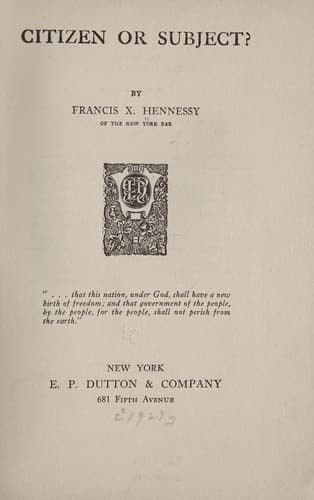
Constitutional history -- United States; United States -- Politics and government; United States. Constitution. 18th Amendment
And so we find the Wheeler brief stating that the new Amendment, made
entirely by governments without any authority from the people about
whom he prates, “is generally recognized as the greatest piece of
constructive _legislation_ that was ever adopted by a self-governing
people”; and we turn over the pages of the brief and we find the
remarkable proposition that these state legislatures, when making
the Eighteenth Amendment, were not _legislating_, but were “a body
of representatives sitting in a conventional capacity.” Of course,
we now learn, by this latter statement, that the greatest piece of
“constructive legislation” the world ever knew was not legislation
at all. But we also learn a more important thing. It would have been
of great advantage to the British Parliament in 1765, if it had only
known the Wheeler concept of our American security for human freedom.
Think how remarkable it would have been to have passed a Stamp Act
which would have been universally respected and obeyed by the American
people of that time! All the British Parliament should have done was
to announce: “This is not passed by us as a legislature. In issuing
this command to the American people, we are a ‘body of representatives
sitting in a conventional capacity.’” Having exactly the same attitude
mentally as Lord North in 1775, this Wheeler would have been a better
Minister for the English King. He would have been able to keep for him
the American “subjects” of the British Legislature.
“Article V itself shows that the representative or convention idea was
in the minds of the framers of the Constitution. If the legislatures
of two thirds of the states should apply to Congress, then Congress
would be obliged to call a convention for proposing Amendments to the
Constitution. Then, also, when it came to the matter of ratification,
this question could be considered by conventions in the various states.
A review of the proceedings of the constitutional convention, as well
as a study of the political and governmental bodies at the time at
which the provision providing for amending the federal Constitution
was adopted, revealed the fact that these men thought in terms of
conventions ... _and that the clear intent of the framers was to ratify
proposed amendments by bodies sitting in the capacity of conventions_.
The Court will not find any able exponent of the theories of government
of that time, however, _who even asserted that the people could be
considered as a portion of the legislature_. This can be shown most
clearly by an examination of the proceedings of the constitutional
convention, as reported by Mr. Madison and particularly by examining
the various proposals advanced in that convention for the ratification
of the Constitution.”
Public-domain text, read in full here on John Shaqi.
Reviews
Reviews
No reviews yet
Be the first to share your thoughts on this work.
Elsewhere in the archive
Join the Discussion
Join the discussion
Sign in to leave a comment or review.
Sign InorCreate an account