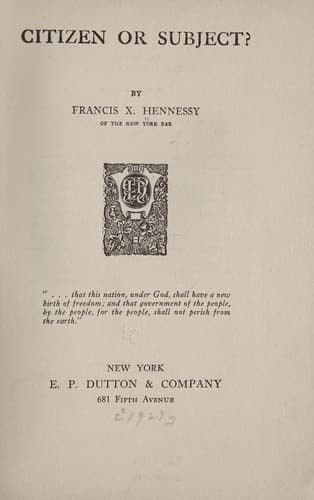
Constitutional history -- United States; United States -- Politics and government; United States. Constitution. 18th Amendment
In every argument against the Eighteenth Amendment, possible changes in
the Constitution (which is both federal and national) have been divided
into two classes, but not into the federal class and the national
class. It has been invariably contended that the first class include
those which _can_ be made under the imaginary “grant” of power in the
Fifth Article and in the mode of procedure therein prescribed. On the
other hand, it has been invariably contended that the other class
includes those which _cannot_ be made under that imaginary “grant” or
in _any_ CONSTITUTIONAL procedure _because_ they take away from the
citizens _of a state_ their right to govern themselves.
All arguments alike, whether for or against the Eighteenth Amendment,
have wholly ignored the fact that the citizens of _America_, for the
protection of the individual liberty of the one American people,
IN THAT CHARACTER, established the Constitution and made it the
supreme law over the citizens of the respective states and the states
themselves and the state governments and the league of the states,
which the citizens of America continued as subordinate to their nation
of men.
For this reason probably, no argument, on either side, has ever
recognized the identity of the “conventions” of the Seventh Article
with the “conventions” of the Fifth Article. For this reason probably,
no argument has ever recognized the identity of both “conventions” with
the most important factor and reservee in the Tenth Amendment, “the
people” of America, as distinguished from the lesser reservees, the
peoples or citizens of each state, “the states respectively.”
It is this very failure to recognize this identity which has forced
the opponents of the new Amendment into the “nonsense” of assuming
and asserting, with their adversaries, that the Fifth Article _is_ a
“grant” to the “conventions” and the state “legislatures.” If there
had not been this failure, everyone would have recognized that the
“conventions,” which made the Constitution, neither could nor did
“grant” to themselves, the “conventions” named in the Fifth Article,
any or all of the very power which they were then exercising. The
“nonsense” of the concept of such a “grant” is patent once there is
recognized the identity between the “conventions” with the most
important reservee of the Tenth Amendment, the one American people of
Marshall.
Public-domain text, read in full here on John Shaqi.
Reviews
Reviews
No reviews yet
Be the first to share your thoughts on this work.
Elsewhere in the archive
Join the Discussion
Join the discussion
Sign in to leave a comment or review.
Sign InorCreate an account