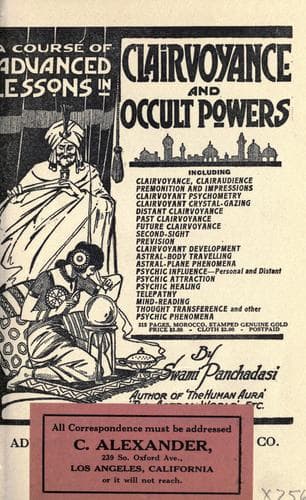
Clairvoyance and Occult PowersAtkinson, William Walker
Religion
Clairvoyance and Occult Powers
Atkinson, William Walker
Clairvoyance
In this connection, before passing on to the consideration of other phases
of psychic phenomena, I would say that one of the best mediums known to
the modern Western world--a medium who has been consulted by eminent men,
university professors, psychologists, and others--and whose revelations
regarding past, present and future astounded careful and intelligent men
of international reputation--this medium at the height of her professional
success made a public announcement that she felt compelled, from
conscientious motives, to assert that she had come to the conclusion that
her message came not from departed "spirits" but rather from some unknown
realm of being, brought hither by the exercise of some faculty inherent in
her and developed to a high power in her for some reason, which power seem
to manifest more effectively when she shut off her ordinary physical
faculties and functioned on a plane higher than them. I think that the
student of the present lessons will be able to point out the nature of the
phenomena manifested by this medium, and also the source of her power. If
not, I shall feel disappointed at my work of instruction.
LESSON XVI.
PSYCHIC INFLUENCE; ITS LAWS AND PRINCIPLES
One of the phases of psychic phenomena that actively engage the attention
of the student from the very beginning is that which may be called Psychic
Influence. By this term is meant the influencing of one mind by
another--the effect of one mind over another. There has been much written
and said on this phase of the general subject in recent years, but few
writers, however, have gone deeply into the matter.
In the first place, most of the writers on the subject seek to explain the
whole thing by means of ordinary telepathy. But this is merely a one-sided
view of the truth of the matter. For, while ordinary telepathy plays an
important part in the phenomena, still the higher form of telepathy, i.e.,
astral thought-transference, is frequently involved. The student who has
followed me in the preceding lessons will understand readily what I mean
when I say this, so there is no necessity for repetition on this point at
this place.
Public-domain text, read in full here on John Shaqi.
Reviews
Reviews
No reviews yet
Be the first to share your thoughts on this work.
Elsewhere in the archive
Join the Discussion
Join the discussion
Sign in to leave a comment or review.
Sign InorCreate an account