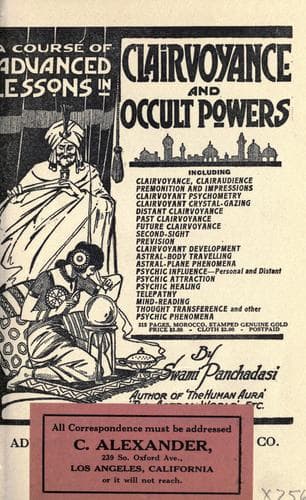
Clairvoyance and Occult PowersAtkinson, William Walker
Religion
Clairvoyance and Occult Powers
Atkinson, William Walker
Clairvoyance
The mind is a very restless thing, and is inclined to dance from one thing
to another, tiring of each thing after a few moment's consideration
thereof. The average person allows his involuntary attention to rest upon
every trifling thing, and to be distracted by the idlest appeals to the
senses. He finds it most difficult to either shut out these distracting
appeals to the senses, and equally hard to hold the attention to some
uninteresting thing. His attention is almost free of control by the will,
and the person is a slave to his perceptive powers and to his imagination,
instead of, being a master of both.
The occultist, on the contrary, masters his attention, and controls his
imagination. He forces the one to concentrate when he wishes it to do so;
and he compels the latter to form the mental images he wishes to
visualize. But this a far different thing from the self-hypnotization
which some persons imagine to be concentration. A writer on the subject
has well said: "The trained occultist will concentrate upon a subject or
object with a wonderful intensity, seemingly completely absorbed in the
subject or object before him, and oblivious to all else in the world. And
yet, the task accomplished, or the given time expired, he will detach his
mind from the object and will be perfectly fresh, watchful and wide-awake
to the next matter before him. There is every difference between being
controlled by involuntary attention, which is species of
self-hypnotization, and the control of the attention, which is an evidence
of mastery." An eminent French psychologist once said: "The authority of
the attention is subject to the superior authority of the Ego. I yield it,
or I withhold it, as I please. I direct it in turn to several points. I
concentrate it upon each point, as long as my will can stand the effort."
In an earlier lesson of this series, I have indicated in a general way the
methods whereby one may develop and train his powers of concentration.
There is no royal road to concentration; it may be developed only by
practice and exercise. The secret consists in managing the attention, so
as to fix it upon a subject, no matter how uninteresting; and to hold it
there for a reasonable length of time. Practice upon some disagreeable
study or other task is good exercise, for it serves to train the will in
spite of the influence of more attractive objects or subjects. And this
all serves to train the will, remember; for the will is actively concerned
in every act of voluntary attention. In fact, attention of this kind is
one of the most important and characteristic acts of the will.
Public-domain text, read in full here on John Shaqi.
Reviews
Reviews
No reviews yet
Be the first to share your thoughts on this work.
Elsewhere in the archive
Join the Discussion
Join the discussion
Sign in to leave a comment or review.
Sign InorCreate an account