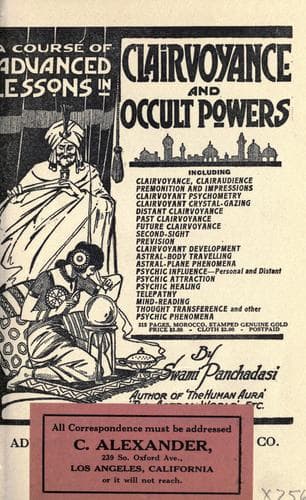
Clairvoyance and Occult PowersAtkinson, William Walker
Religion
Clairvoyance and Occult Powers
Atkinson, William Walker
Clairvoyance
Mrs. Broughton awoke one night in 1844, and roused her husband, telling
him that something dreadful had happened in France. He begged her to go
asleep again, and not trouble him. She assured him that she was not asleep
when she saw what she insisted on telling him--what she saw in fact. She
saw, first, a carriage accident, or rather, the scene of such an accident
which had occurred a few moments before. What she saw was the result of
the accident--a broken carriage, a crowd collected, a figure gently raised
and carried into the nearest house, then a figure lying on a bed, which
she recognized as the Duke of Orleans. Gradually friends collected around
the bed--among them several members of the French royal family--the queen,
then the king, all silently, tearfully, watching the evidently dying duke.
One man (she could see his back, but did not know who he was) was a
doctor. He stood bending over the duke, feeling his pulse, with his watch
in the other hand. And then all passed away, and she saw no more. "As
soon as it was daylight she wrote down in her journal all that she had
seen. It was before the days of the telegraph, and two or more days passed
before the newspapers announced 'The Death of the Duke of Orleans.'
Visiting Paris a short time afterwards, she saw and recognized the place
of the accident, and received the explanation of her impression. The
doctor who attended the dying duke was an old friend of hers, and as he
watched by the bed his mind had been constantly occupied with her and her
family."
In many cases of clairvoyance of this kind, there is found to exist a
strong connecting link of mutual interest or affection, over which flows
the strong attention-arousing force of need or distress, which calls into
operation the clairvoyant visioning.
In other cases there seems to be lacking any connecting link, although,
even in such cases there may be a subconscious link connecting the
clairvoyant with the scene or event. An interesting example of this last
mentioned phase is that related by W.T. Stead, the English editor and
author, as having happened to himself. Mr. Stead's recital follows:
Public-domain text, read in full here on John Shaqi.
Reviews
Reviews
No reviews yet
Be the first to share your thoughts on this work.
Elsewhere in the archive
Join the Discussion
Join the discussion
Sign in to leave a comment or review.
Sign InorCreate an account