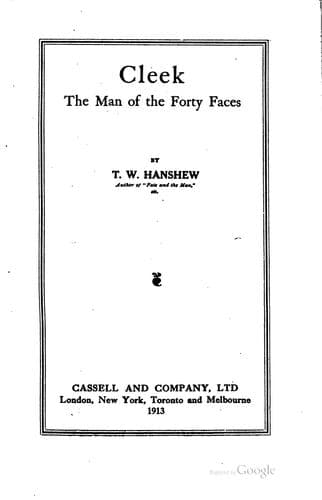
Cleek: the Man of the Forty FacesHanshew, Thomas W.
General
Cleek: the Man of the Forty Faces
Hanshew, Thomas W.
Cleek, Hamilton (Fictitious character) -- Fiction; Detective and mystery stories; Police -- Great Britain -- Fiction
"Yes. He declined utterly. But it was a case of the crushed worm, with
Zuilika. Now was _her_ turn; and she would not abate one jot or tittle.
There was a stormy scene, of course. It ended by Ulchester and the woman
Anita leaving the house together. From that hour Zuilika never again
heard his living voice, never again saw his living face! He seems to
have gone wild with wrath over what he had lost and to have plunged
headlong into the maddest sort of dissipation. It is known--positively
known, and can be sworn to by reputable witnesses--that for the next
three days he did not draw one sober breath. On the fourth, a note from
him--a note which he was _seen_ to write in a public house--was carried
to Zuilika. In that note he cursed her with every conceivable term; told
her that when she got it he would be at the bottom of the river, driven
there by her conduct, and that if it was possible for the dead to come
back and haunt people he'd do it. Two hours after he wrote that note he
was seen getting out of the train at Tilbury and going towards the
docks; but from that moment to this every trace of him is lost."
"Ah, I see!" said Cleek reflectively. "And you want to find out if he
really carried out that threat and did put an end to himself, I suppose?
That's why you have come to me, eh? Frankly, I don't believe that he
did, Major. That sort of a man never commits suicide upon so slim a
pretext as that. If he commits it at all, it's because he is at the end
of his tether--and our friend 'Zyco' seems to have been a long way from
the end of his. How does the lady take it? Seriously?"
"Oh, very, sir, very. Of course, to a woman of her temperament and with
her Oriental ideas regarding the supernatural, _et cetera_, that threat
to haunt her was the worst he could have done to her. At first she was
absolutely beside herself with grief and horror; swore that she had
killed him by her cruelty; that there was nothing left her but to die,
and all that sort of thing; and for three days she was little better
than a mad woman. At the end of that time, after the fashion of her
people, she retired to her own room, covered herself with sackcloth and
ashes, and remained hidden from all eyes for the space of a fortnight,
weeping and wailing constantly and touching nothing but bread and
water."
"Poor wretch! She suffers like that, then, over a rascally fellow not
worth a single tear. It's marvellous, Major, what women do see in men
that they can go on loving them. Has she come out of her retirement
yet?"
Public-domain text, read in full here on John Shaqi.
Reviews
Reviews
No reviews yet
Be the first to share your thoughts on this work.
Elsewhere in the archive
Join the Discussion
Join the discussion
Sign in to leave a comment or review.
Sign InorCreate an account