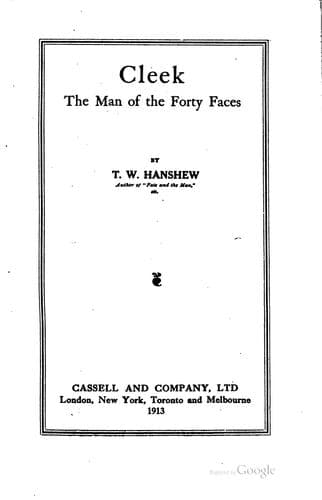
Cleek: the Man of the Forty FacesHanshew, Thomas W.
General
Cleek: the Man of the Forty Faces
Hanshew, Thomas W.
Cleek, Hamilton (Fictitious character) -- Fiction; Detective and mystery stories; Police -- Great Britain -- Fiction
For some unexplained reason, Miss Lorne's letters--never very frequent,
and always very brief--had, of late been gradually growing briefer: as
if written in haste and from a mere sense of duty and at odd moments
snatched from the call of more absorbing things; and, finally, there
came a dropping off altogether and a week that brought no message from
her at all.
The old restlessness, the almost outlived sense of personal injury and
rebellion against circumstances, took hold of Cleek again when that time
came; and the soul of him drank deep of the waters of bitterness.
So, then, it was all to be in vain, was it, this long struggle with the
Devil of Circumstances, this long striving for a Goal? And after all,
"Thou shalt not enter" was to be written over the gateway of his
ambition? He had been lifted only to be dropped again, redeemed only to
let him see how vain it was for the leopard, even though he achieved the
impossible and changed his spots, to be other than a leopard always; how
impossible it was for a man to override the decrees of Nature or evade
the edicts of Providence? That was what it meant, eh?
To a nature such as his, Life was always a picture drawn out of
perspective. There was never any Middle Distance; never any proper
gradation. It was always either the Highest Heights or the Lowest
Depths; the glare of fierce light or the black of deepest darkness. He
could not plod; he must either fly or fall; either loll at the Gates of
Paradise or groan in the depths of Hell. And the failure of Ailsa
Lorne's letters sent him to the darkest and most hopeless corner of it.
Not that he blamed her--wholly; but that he blamed that Fate which had
so persistently dogged him from childhood on. For now that the letters
had ceased altogether, he recalled things which otherwise would have
been forgotten; and, his sense of proportion being distorted, made
mountains out of sand dunes.
In one of those letters, he recollected, she had spoken of meeting
unexpectedly an old friend whom she had not seen since the days of his
boyhood; in another, she had casually remarked, "I met Captain Morford
again to-day and we spent a very pleasant half hour together," and in a
third had written, "The Captain promised to call and take tea to-day but
didn't. I rather fancy he divines the fact that Lady Chepstow does not
care for him. Indeed, she dislikes him immensely. Why, I wonder?
Personally, I think him exceedingly pleasant, and there are things in
his character for which I have the deepest respect and admiration."
And out of these trifling circumstances--lo! the darkest corner that
darkest Hell contained.
So that was how it was to end, was it? That was the card which Fate had
all along kept up her sleeve while she stood off laughing at his
endeavours, his hopes, his struggles against the inevitable? In the end,
another man was to appear, another man was to win her, and the dream was
to turn out nothing more than a dream after all.
Public-domain text, read in full here on John Shaqi.
Reviews
Reviews
No reviews yet
Be the first to share your thoughts on this work.
Elsewhere in the archive
Join the Discussion
Join the discussion
Sign in to leave a comment or review.
Sign InorCreate an account