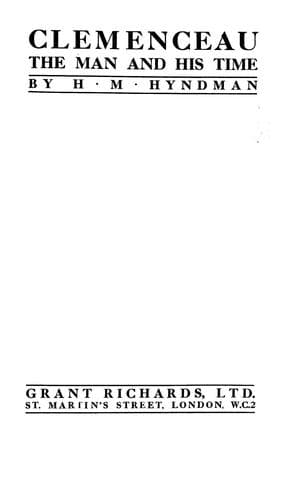
Clemenceau, the Man and His TimeHyndman, H. M. (Henry Mayers)
History
Clemenceau, the Man and His Time
Hyndman, H. M. (Henry Mayers)
Clemenceau, Georges, 1841-1929; France -- Politics and government -- 1870-1940
of oppression on the part of the capitalist class caused Clemenceau to
support Socialists more and more in their demands for limitation of
the then unrestricted powers of individual employers and "anonymous"
companies. So, too, individualist as he was, he wrote article after
article in defence of the right of the men to strike against grievous
oppression, holding that the combination of the workers was more than
sufficiently handicapped by the fact that they were bound to imperil
their own subsistence as well as the maintenance of their wives and
children by going on strike at all. This argument he applied to all
strikes in organised industries.
But Clemenceau naturally found himself drawn into bitter antagonism
to the doctrine of _laissez-faire_ and the law of supply and demand.
"You say all must bow down to them. I contend all must revolt against
them." "The individual struggle for existence is only a great
_laissez-faire_! Far from being liberty, it is the triumph of violence,
it is barbarism itself. The man who mastered the first slave founded
a new system . . . so completely that after some ages of this rule a
physiocrat overlooking it all would have sagely pronounced: Slavery is
the law of human societies. This with the same amount of truth as he
says to-day: The law of supply and demand is an immutable ordinance.
And, for all that, the supreme irony of fate has decreed that the
first slave-driver was at the same time the first sower of the seed of
liberty, of justice. For by enslaving men he created a social relation,
a relation different from that enjoined by the primitive form of the
struggle for existence: kill, eat, destroy. Henceforth man was bound to
man. The social body was formed." Man had to discover the law governing
the new relation, and he found it at last in the first flashes of
justice and liberty. "What, then, is this your _laissez-faire_, your
law of supply and demand, but the pure and simple expression of force?
Right overcomes force: that is the principle of civilisation. Your law
once formulated, let us set to work against barbarism!"
All that is telling criticism; though to-day it reads a bit antiquated
in view of the revolt everywhere against both these catch-phrases and
the anarchist chaos which they connote. But here again Clemenceau,
with all his acuteness and brilliancy, displays the need for a guiding
historic and economic theory--the sociologic theory which scientific
Socialism supplies. It was not justice or liberty which created
slavery, or destroyed slavery, but economic development and social
necessity. The cult of abstraction leads to social revolt but not to
material revolution.
Public-domain text, read in full here on John Shaqi.
Reviews
Reviews
No reviews yet
Be the first to share your thoughts on this work.
Elsewhere in the archive
Join the Discussion
Join the discussion
Sign in to leave a comment or review.
Sign InorCreate an account