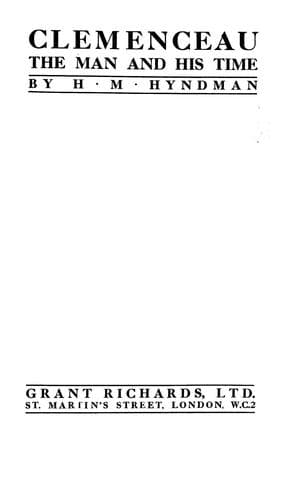
Clemenceau, the Man and His TimeHyndman, H. M. (Henry Mayers)
History
Clemenceau, the Man and His Time
Hyndman, H. M. (Henry Mayers)
Clemenceau, Georges, 1841-1929; France -- Politics and government -- 1870-1940
But science, as we know, has revealed the horrors as well as the
wonders of earth. It troubles us; man has shed rivers of needless
blood, but we shrink from recognising Nature as she is, "red in
tooth and claw." It did not trouble the ancient Greeks; their
gods, developing from the rough deities of place or tribe into the
embodiments of the natural forces of matter or of mind, were outside
human ethic, although they were cast in human form. They might take the
shape of mortals, but only Euripides and a few other hypersensitive
moralists thought of blaming the gods when, as often happened, they
fell below the standards of human conduct. But we are creatures of
another era; and man, criticising and even condemning the Powers that
rule his little day, has, for good or ill, reached out to a level that
is above the gods, whose plaything he still remains.
And there is another change. Man--_some_ men, that is to say--have
taken the animals into their protection and fellowship: and M.
Clemenceau is truly one of these. Not only those charming, kindly
essays, _La Main et la Patte_ and _Les Parents Pauvres_, in _Le Grand
Pan_, but the history of the two pigeons in the _Embuscades de la Vie_,
and a hundred little touches and incidents throughout Clemenceau's
books show him to be a man of most generous sympathies, looking at
animal life from a far higher and finer point of view than the majority
of his countrymen.
There is much else in _Le Grand Pan_ that it would be pleasant to dwell
upon: a delicate classic spirit, a certain ironic grace, humour and
mockery, but everywhere and above all keen indignation at needless
human suffering and a sympathy which is poles apart from sentiment, for
human pain. M. Clemenceau might well be called "a soldier of pity,"
as, in one of the Near Eastern languages, the members of his first
profession, the doctors, are termed. But I must pass on. _Le Grand Pan_
is, as it deserves to be, the best known of M. Clemenceau's books,
and no one who has overlooked it can form a complete idea of this
remarkable man.
Public-domain text, read in full here on John Shaqi.
Reviews
Reviews
No reviews yet
Be the first to share your thoughts on this work.
Elsewhere in the archive
Join the Discussion
Join the discussion
Sign in to leave a comment or review.
Sign InorCreate an account