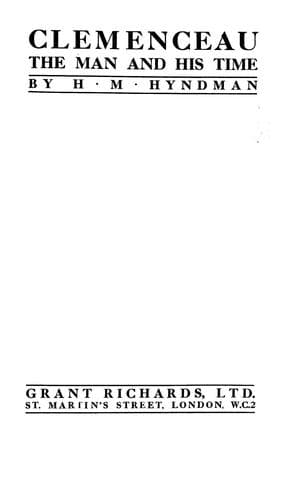
Clemenceau, the Man and His TimeHyndman, H. M. (Henry Mayers)
History
Clemenceau, the Man and His Time
Hyndman, H. M. (Henry Mayers)
Clemenceau, Georges, 1841-1929; France -- Politics and government -- 1870-1940
Henri de Puymaufray, a ruined French gentleman, who has lost the
world and found a kind of Radicalism, and Dominique Harlé, a rich
paper manufacturer, live side by side in the country as friendly
enemies or, rather, close but inimical friends. Their views of life
are as the poles asunder, but for the purposes of the story they
must be constantly meeting in conversational intimacy; and they have
each an almost superhuman power of expressing themselves and their
attitude towards the world they live in. The chief link between them
is Harlé's supposed daughter and only child, Claude, whose real father
is Puymaufray. Both these elderly gentlemen are deeply concerned
about Claude's future; each wishing, as parents and guardians often
do, to make the child's career the completion of their own ambitions
and hopes. Here Harlé has the advantage; he knows what he wants, that
is, money and power, and he means his daughter to have plenty of
both. He is the ordinary capitalist, with a strain of politician and
Cabinet-maker, who ends by founding a popular journal that outdoes
Harmsworth in expressing the "Lowest Common Factor of the Mind."
Society, the Church, and a particularly offensive form of charity all
serve him to increase his own power and the stability of his class. All
is for the best in the best of bourgeois worlds. Such is the theory
of life which he puts before his supposed daughter, together with a
_prétendant_ who will carry out his aims. Unhappily, Puymaufray has
nothing positive to set against this very solid and prosperous creed.
He and Deschars, the young traveller whom he wishes to give Claude
for a husband, can only talk pages of Radicalism in which the words
"pity" and "love" would recur even more frequently if M. Clemenceau's
fine sense of fitness did not prevail. What do they really want Claude
to do? The best they can offer her appears to be a life of retired and
gentle philanthropy, inspired by a dim sense of human brotherhood,
which might, under very favourable circumstances, deepen into a sort of
Socialist mood.
But "mere emotional Socialism cuts no ice." This has often been said,
and means that a vague fraternal purpose and a perception of the deep
injustice of our present social system, even when sharpened with the
most destructive satire, will never change this world for the better,
unless they lead up to some theory of construction that is based on
economic facts. Pity and brotherhood may move individuals to acts of
benevolence, but they cannot alone recast the fabric of society, or
even bring about fundamental collective reforms. Besides, when young
people are asked to give up certain definite things, such as money,
pleasure and power, they must see something more than mere renouncement
ahead. They must be shown the fiery vision of an immortal city whose
foundations they may hope to build. Clemenceau's own knowledge of human
nature works against his two heroes, and he says:
Public-domain text, read in full here on John Shaqi.
Reviews
Reviews
No reviews yet
Be the first to share your thoughts on this work.
Elsewhere in the archive
Join the Discussion
Join the discussion
Sign in to leave a comment or review.
Sign InorCreate an account