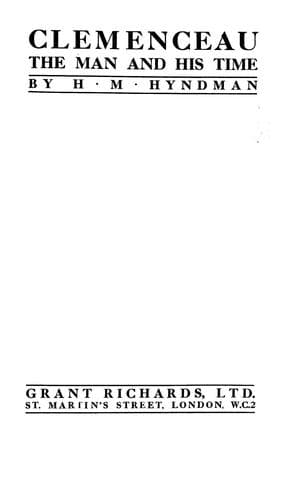
Clemenceau, the Man and His TimeHyndman, H. M. (Henry Mayers)
History
Clemenceau, the Man and His Time
Hyndman, H. M. (Henry Mayers)
Clemenceau, Georges, 1841-1929; France -- Politics and government -- 1870-1940
If the employers were in the wrong, as it appears they were, then to
call out the military to protect those miners who showed themselves
ready to make immediate terms with injustice was, however good the
intention, to take sides against the main body of the men. So it
seemed to these latter. When, therefore, the soldiers defended the
non-strikers, the strikers assailed the military, who had not attacked
them. Clemenceau accordingly decided that the strikers had broken the
law, as undoubtedly they had, by stoning and injuring the servants of
the State, who were upholding the law as it stood. The truth is that,
so long as these antagonistic sections exist among the working class,
and persist in fighting one another, it is practically impossible for
the State not to intervene in order to keep the peace. There may be
no sympathy with blacklegs, but the Minister of the Interior could
scarcely be blamed for protecting them against an infuriated mob, which
would probably have killed them, or for insisting upon the release of
those whom the strikers had seized. That the temper of the crowd had
become highly dangerous was apparent a little later, when the Socialist
Mayor was knocked down as he was trying to calm them.
All this rendered M. Clemenceau's second and third visits to the scene
of class warfare far more stormy than the first. Owing to the horror
and hatred created by the avoidable holocaust in the Courrières mines,
and the further discovery that engineers appointed by the State had
played into the hands of the employers, the situation got worse from
day to day. The strike itself was not only an effort to get more wages,
but a declaration of hostility to the mine-owners, and those of the
miners' own class who showed any tenderness towards them, or were ready
to take work under them. Their own leaders and representatives had
no longer any influence with the men or control over them. M. Basly,
the deputy who acted throughout for the miners, had as little power
over the strikers as anybody else. The whole movement was taking an
anarchist turn. Also, agents were at work among them both from the
reactionary and the revolutionary side whose main object, for very
different reasons, was to foster disturbance and influence passion.
Foreign emissaries likewise were said to be at work.
Public-domain text, read in full here on John Shaqi.
Reviews
Reviews
No reviews yet
Be the first to share your thoughts on this work.
Elsewhere in the archive
Join the Discussion
Join the discussion
Sign in to leave a comment or review.
Sign InorCreate an account