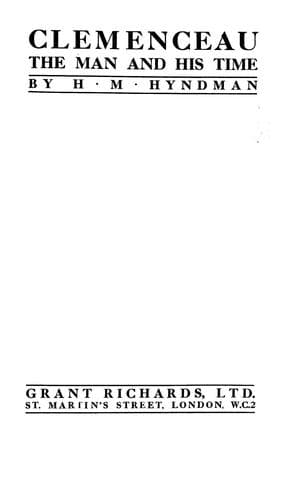
Clemenceau, the Man and His TimeHyndman, H. M. (Henry Mayers)
History
Clemenceau, the Man and His Time
Hyndman, H. M. (Henry Mayers)
Clemenceau, Georges, 1841-1929; France -- Politics and government -- 1870-1940
But stay a moment: here is M. Jaurès. He has a word to say. What are
you doing, M. Clemenceau? You are outraging all your own principles.
You are interfering with that very right to strike which you yourself
have declared to be sacred. You are using the military discipline of
the comrades of the men out on strike against the electrical companies,
to render their protest nugatory, by employing the sappers against
them. You have, in fact, called out the powers of the State to crush
the workers in a particular industry. If you were true to yourself,
you would convert the electrical supply of Paris now in the hands of
greedy monopolists into a public service, and give the strikers every
satisfaction. That is the only real solution of social anarchy.
To him Clemenceau: "But this was not merely a strike or a limited
liability class war against employers. It was a bitter fight between
two irreconcilable antagonists against inoffensive passers-by. The
people of Paris, for whom I am concerned, had nothing to do with the
matter. I myself knew nothing about the decision to strike till my own
work was rendered impossible by the sudden infliction of darkness upon
me by these resuscitated Joshuas. Not only was the general security
threatened, as I have declared, but the lives of your own clients,
Jaurès, were threatened by immersion in a flood below ground. The
inundation of the Metropolitan (the Underground Railway) had already
begun. The workers of Paris who used that means of communication in
order to return to their work would most certainty have been drowned
owing to the suspension of electrical pumps and lifts, had not the
sappers and the firemen, both of them sets of public functionaries,
rushed at once to the rescue. Were the workmen of Paris engaged in
other departments to be allowed to perish, with the State standing
by, wringing its hands in hopeless ineptitude, while the electrical
engineers got the better of their masters in a dispute about wages?
This was a practical question which I had to decide at once. I decided
in favour of the inoffensive people of Paris and against the electrical
engineers on strike."
Taking a wide view of the whole question, I hold Jaurès's opinion
to be the right one. But Clemenceau had to deal with an immediate
practical difficulty of a very serious kind indeed. The lights went
out at six o'clock. Night was coming on. No time could be lost in
negotiating with the engineers. Still less was nightfall the period
when a public service could be instituted in hot haste. The matter
was settled in that form and for that occasion. But none the less
the real point at issue was not thus easily disposed of. Clemenceau
was right in preventing Paris from being left all night in darkness.
Jaurès was right in claiming that the State should have a more definite
and consistent policy than that of dealing with differences between
wage-earners and employers by such hand-to-mouth methods.
Public-domain text, read in full here on John Shaqi.
Reviews
Reviews
No reviews yet
Be the first to share your thoughts on this work.
Elsewhere in the archive
Join the Discussion
Join the discussion
Sign in to leave a comment or review.
Sign InorCreate an account