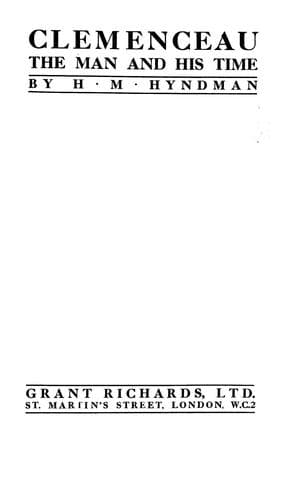
Clemenceau, the Man and His TimeHyndman, H. M. (Henry Mayers)
History
Clemenceau, the Man and His Time
Hyndman, H. M. (Henry Mayers)
Clemenceau, Georges, 1841-1929; France -- Politics and government -- 1870-1940
If it might be urged that he occasionally used too many words to
express his meaning, this was easily forgiven by his countrymen, on
account of his admirable turn of phrase and his understanding use of
the modulations of the French language. However prejudiced his hearers
might be against him (and his personal appearance was not such as to
disarm an opponent), they had only to listen to Jaurès for ten minutes
to feel interested in what he had to say. From this to admiration and
excitement was no long step. Short, stout and somewhat cumbrous in
figure, wearing trousers nearly halfway up his calves, with a broad,
humorous, rather coarse face, his eyes full of expression and not
wanting in fun, troubled with a curious twitching on the right cheek
which affected his eye with a sort of wink, Jaurès was certainly not
the personality anyone would have fixed upon as the greatest master
of idealist and economic Socialist oratory in France, and perhaps
in Europe. But his sincerity, his eloquence soon overcame these
drawbacks on the platform and in the tribune, just as his bonhomie
and good-fellowship did in private life. He had been a Professor
of Literature in the University of Toulouse, and was a man of wide
cultivation. But his learning never made him pedantic, nor did his
great success turn his head. Gifted with extraordinary vitality, his
powers of work were quite phenomenal. To say that he "toiled like
a galley-slave," for the cause to which he devoted himself, was no
exaggeration. Yet he was always fresh, always in good spirits, always
ready to contribute wit and vivacity to any company in which he found
himself. Add to this much practical good sense in the conduct of his
party and the affairs of the world, and all must admit that in Jaurès
the Socialist party of France had a worthy chief and Clemenceau a
worthy antagonist. The galleries, like the Assembly itself, were always
crowded when either orator was expected to address the House.
Jaurès dealt with the development of society from the chaos of
conflicting classes and mutual antagonisms to the co-ordination of
common effort for the common good. This can and should be a peaceful
social evolution. Property for all means a universal share, not only in
politics, but in the production and the distribution of wealth. This
could not be obtained under the conditions of to-day, where those who
possessed no property but the labour in their bodies were at the mercy
of the classes who possessed all else; where only by strikes in which
the State took the side of the employers could the wage-earners obtain
an infinitesimal portion of their rights. By collectivism, leading up
to Socialism and general co-operation, every individual would have a
direct interest in and be benefited by the general social increase of
wealth, due to the growing powers of man to produce what is useful and
beneficial to all.
Public-domain text, read in full here on John Shaqi.
Reviews
Reviews
No reviews yet
Be the first to share your thoughts on this work.
Elsewhere in the archive
Join the Discussion
Join the discussion
Sign in to leave a comment or review.
Sign InorCreate an account