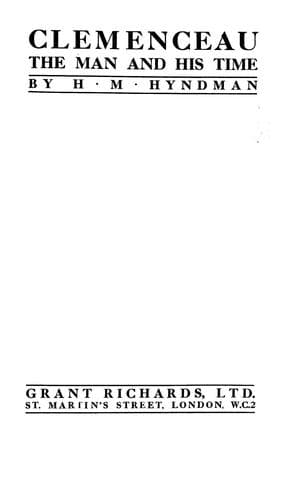
Clemenceau, the Man and His TimeHyndman, H. M. (Henry Mayers)
History
Clemenceau, the Man and His Time
Hyndman, H. M. (Henry Mayers)
Clemenceau, Georges, 1841-1929; France -- Politics and government -- 1870-1940
"Here we have it. An eight-hours working day for all trades. The
right of State Employees to form Trade Unions and to strike.
Proportional Representation. A progressive Income Tax, and so on. A
nice little programme, but a bourgeois programme all the same. No
idealism, no Socialism there! M. Jaurès, however, claims the immediate
Nationalisation and Socialisation of all departments of industry,
including the land. But such unification of society is in reality the
Catholicisation of Society. There is a definite programme of Radical
Reforms, nevertheless, constituting an advance towards a Socialist
policy. They are formulated by the bourgeoisie, but Socialists threaten
to vote against the Budget, which is necessary in order to carry out
some of their own proposals. Take Old Age Pensions. These need money.
The Socialists refuse the required funds. Yet Socialists are for the
Republic. So far we cordially agree. So far I, of necessity, work
with them. But if they at the same time denounce Republicans as the
enemies of the workers and secure a majority of votes in that sense,
then that is to vote for the defeat of the Republic. If Socialists
would work with the Radicals, in order to attain the ends they have in
common, none would be more glad than I. But if such common action is
impossible, then let each work on in their own way."
It was said at the time that at the close of the debate, when
Clemenceau was leaving the Assembly, he remarked to Jaurès, "After all,
Jaurès, you are not the good God." To which Jaurès replied: "And you
are not even the Devil."
I have dealt with this famous controversy at some length, without
attempting to give the speeches in full, because, although the
discussion led to no decision at the moment, it certainly brought
before the public of France and even the public opinion of Europe
the direct theoretical and practical difference between Socialism and
well-meaning Radicalism, in an intelligible manner, as nothing else
would. The effect upon French politics within the next few months, in
spite of further desperate outbreaks in 1907, was also remarkable.
Jaurès's speech did much to consolidate the Socialist Party as a
unified section of the Chamber; and Clemenceau himself was so far
influenced by it and by the trend of events that, as will be seen,
it affected his policy as Prime Minister in the formation of his own
Cabinet shortly afterwards. Looking at the matter from the Socialist
point of view, therefore, Jaurès was building better than his opponents
in the Chamber knew, and Socialists had no reason to regret the
apparent victory of his formidable antagonist at the time. In fact, as
Bernard Shaw said in regard to a very different debate under widely
different circumstances in London more than thirty years before: "The
Socialist was playing at longer bowls than you know."
Public-domain text, read in full here on John Shaqi.
Reviews
Reviews
No reviews yet
Be the first to share your thoughts on this work.
Elsewhere in the archive
Join the Discussion
Join the discussion
Sign in to leave a comment or review.
Sign InorCreate an account