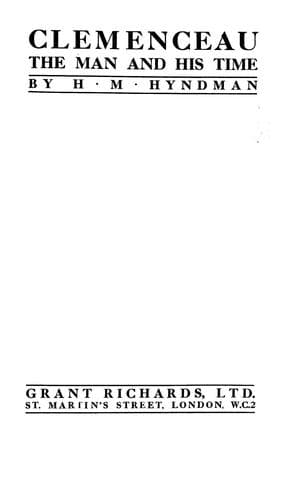
Clemenceau, the Man and His TimeHyndman, H. M. (Henry Mayers)
History
Clemenceau, the Man and His Time
Hyndman, H. M. (Henry Mayers)
Clemenceau, Georges, 1841-1929; France -- Politics and government -- 1870-1940
France was passing through a very difficult period. Whatever view a
thoroughgoing Socialist may take as to the need for a wider general
policy than that adopted by Clemenceau, it is not easy to see how, the
French people being unprepared to accept a purely Labour or Socialist
Government, the Republic could have been peacefully maintained, but
for the cool determination of the Radical Republican at the head
of affairs. Scarcely a day passed without some fresh economic and
social conflicts that called for prompt action. These, however, arose
in provinces and cities and under conditions where the antagonism
between wage-earners and employers, between capital and labour, in
the ordinary way offered no exceptional features for the statesman.
But in the spring and summer of 1907 a more complicated and dangerous
uprising, which developed into little short of an attempt at an
Anarchist-communist, anti-Republican revolution, broke out in the South
of France among the wine-growers.
The peasants of the districts round Narbonne and Montpellier, together
with many of the inhabitants of those towns, who were themselves
dependent upon the wine industry, made, in fact, a desperate local
attack upon the existing Government of France. Disaffection had
been growing for a long time and was due to a series of economic
and agricultural troubles among the wine-growers, which successive
Ministries had not understood, far less attempted to cope with. It had
its direct origin in a natural cause. This cause was the appearance in
the Bordeaux country of the deadly enemy of all _vignerons_, large and
small--the much-dreaded phylloxera. The vineyards of the Gironde were
devastated and the famous clarets shipped from Bordeaux ceased to be
the product of Bordeaux grapes. Thereupon the inferior vintages of the
Midi came into abnormal demand. But the wine-producers of the West were
not wholly defeated, even while the phylloxera continued his ravages
and no method of checking the mischief had been discovered. There are
ways and means of meeting even such a calamity.
"Would your lordship like madeira served with that course?" said a
butler to a well-known bishop who was giving a dinner, in days long
before the war, to a number of his clergy. "Madeira!" was the reply, in
great surprise. "Why, I have not a single bottle in my cellar." "Oh,
yes, my lord, you have. _Monseigneur oublie peut-être que je suis de
Cette._" Madeira, so the story goes, was duly served. But Cette is not
the only town in France where the art of blending and refining wine
for foreign and even home palates has been brought to a high pitch. At
any rate, during the phylloxera period, Australian, Algerian, Spanish
and other wines, which previously had been regarded contemptuously by
foreign and French consumers of claret, were, it was alleged, imported
at Bordeaux in great quantity and came out again with the old familiar
Bordeaux labels and duly impressed corks.
Public-domain text, read in full here on John Shaqi.
Reviews
Reviews
No reviews yet
Be the first to share your thoughts on this work.
Elsewhere in the archive
Join the Discussion
Join the discussion
Sign in to leave a comment or review.
Sign InorCreate an account