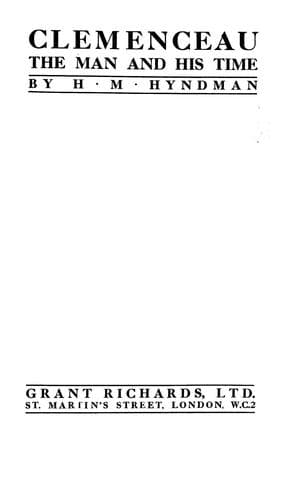
Clemenceau, the Man and His TimeHyndman, H. M. (Henry Mayers)
History
Clemenceau, the Man and His Time
Hyndman, H. M. (Henry Mayers)
Clemenceau, Georges, 1841-1929; France -- Politics and government -- 1870-1940
No trifling storm it was. The whole countryside, in the late spring and
summer, was aflame. Commune after commune, district after district,
took part in the agitation. Peasants and _prolétaires_ made common
cause against the authorities. Taxes should not be paid. Tax-gatherers
should appear at their peril. The Government was an unjust Government,
and should be defied. And it was so. Meetings were held in every town
and village. Capable representatives and leaders, of whom a M. Albert
was the chief, were chosen by the men themselves. Attempts to confer
with the people as a whole resulted in failure. The old story was told
again. The reactionaries of the Right took the side of the people, and
shouted against "adulteration," because they were victims of a chaotic
economic system, because also they objected to the use of troops, who
belonged to and were paid by the whole people, in order to maintain
that system in full vigour. What was to be done? Things got worse
and worse. The Minister of the Interior felt obliged to call out the
troops in order to prevent downright ruin being wrought in Narbonne,
Montpellier and St. Béziers. There were killed and wounded on both
sides. Hence a serious ministerial crisis was threatened which, as
matters stood, could scarcely fail to tell in favour of reaction and
against the only Republic then possible.
The facts were beyond dispute. In consequence of the causes and results
summarised, the temper of the people became unmanageable. There were
terrible riots of a wholly anarchist character. The doors of public
buildings were soaked with kerosene and then set on fire. At Narbonne,
Montpellier and St. Béziers attacks were made on peaceful citizens
at dead of night by uncontrolled mobs of armed men recruited from
the worst members of the population. Soldiers on the spot refused to
fire in reply to revolver shots aimed at them. The provocations to
the troops, who were brought in solely to maintain order, were almost
intolerable, but they were borne with heroic calm. At first they fired
in the air. Then they fired in earnest, and there were killed and
wounded on both sides. Hence there was the greatest excitement in the
Chamber and unrest throughout Paris, where the wildest rumours were
spread.
Public-domain text, read in full here on John Shaqi.
Reviews
Reviews
No reviews yet
Be the first to share your thoughts on this work.
Elsewhere in the archive
Join the Discussion
Join the discussion
Sign in to leave a comment or review.
Sign InorCreate an account