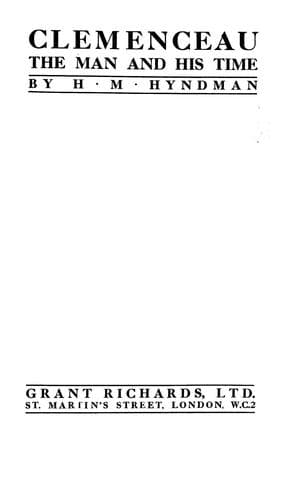
Clemenceau, the Man and His TimeHyndman, H. M. (Henry Mayers)
History
Clemenceau, the Man and His Time
Hyndman, H. M. (Henry Mayers)
Clemenceau, Georges, 1841-1929; France -- Politics and government -- 1870-1940
CHAPTER XV
STRENGTH AND WEAKNESS OF CLEMENCEAU
Strikes and anarchist troubles, however, formidable as they were in the
North and in the South, were by no means the only serious difficulties
which Clemenceau had to cope with, first as Minister of the Interior
and then as Premier. The danger from Germany, as he well knew, was
ever present. Anxious as France was to avoid misunderstandings which
might easily lead to war, eager as the Radical leader might be to
enlarge upon the folly and wickedness of strife between two contiguous
civilised peoples, who could do so much for one another, it was always
possible for the German Government to put the Republic in such a
position that the alternative of humiliation or hostilities must be
faced. Less than a year before Clemenceau accepted office, the German
Kaiser himself had taken a most provocative step in Morocco, the object
of which can now be clearly seen. Germany had no real interests in
Morocco worthy of the name. Several years later the German Minister of
Foreign Affairs pooh-poohed the idea that Germany, distant from Morocco
as she was, with only 200 Germans in the country, and not more than
£200,000 worth of yearly commerce, all told, with the inhabitants,
could be concerned about political matters in that Mohammedan kingdom.
With France the case was very different. Algeria was adjacent to the
territories of the Sultan of Morocco, and, if the wild tribes on the
frontier were stirred up against the infidel, the most important French
colony was threatened with serious disturbance. It was all-important
for France, therefore, that there should be a government at Fez strong
enough and enlightened enough to keep peace on the border. Clemenceau,
who had always been so stern an opponent of colonial adventures, and
had overthrown several Cabinets which he considered were prone to
encourage harmful exploits, had himself spoken out very plainly about
Morocco. Long before capitalist interests were involved on any large
scale the French ownership of Algeria necessitated a definite Moroccan
policy. This again brought with it the obligation of constant pressure
upon the Sultan to induce him to consider French interests. These
interests could be harmonised with those of Spain and Great Britain,
and were so settled by special agreements in April, 1904, just a year
before the German Emperor's _coup de théâtre_ startled the world.
France's special interests in Morocco were thus recognised all round,
and Germany, far from raising any objection, expressly disclaimed any
desire to interfere, so long as "the open door" was left for German
goods. But the general antagonism between France and Germany was a
matter of common knowledge.
Public-domain text, read in full here on John Shaqi.
Reviews
Reviews
No reviews yet
Be the first to share your thoughts on this work.
Elsewhere in the archive
Join the Discussion
Join the discussion
Sign in to leave a comment or review.
Sign InorCreate an account