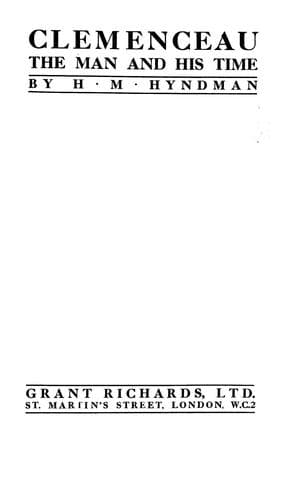
Clemenceau, the Man and His TimeHyndman, H. M. (Henry Mayers)
History
Clemenceau, the Man and His Time
Hyndman, H. M. (Henry Mayers)
Clemenceau, Georges, 1841-1929; France -- Politics and government -- 1870-1940
instead of scattering any portion of them abroad, the expenditure
upon thorough education and scientific agricultural and industrial
experiments. All this even Imperialist Frenchmen can see now.
So with regard to Russia. The alliance of the French Republic with the
Empire of Russia gave France, apparently, a better position in Europe,
the pusillanimous and short-sighted English statesmen having rejected
an alliance which was afterwards forced upon Great Britain when wholly
unprepared for war. Here also Clemenceau's views were justified by
the event. The close connection between a democratic Republic and an
autocratic Empire put France in an unenviable moral position before
the world. More materially serious than this ill-fated combination,
ethically, was the necessity imposed upon the French of lending
continually to Russia, until the total amount of the Russian loans held
in France amounted to many hundreds of millions sterling.
Such huge sums, again, would have been far more advantageously spent
at home than in building strategical and other railways, and financing
gold and other mines, in the vast Muscovite Empire. Financiers gained
largely by these loans. But the peasants and small bourgeoisie
of France were unknowingly dependent for their interest upon a
poverty-stricken agricultural population, which could not possibly
continue to pay the large sum due yearly on this amount to their
Western creditors without utter ruin. Thus unsound finance followed
hard on the heels of more than doubtful policy, and France was the
weaker and the poorer for both.
This was all the more fatal to real French interests, inasmuch that,
at the same time, the home population of the Republic was slowly
decreasing, while the population of her threatening rival, Germany,
was steadily growing, and the wealth of the German Empire, both
agricultural and mineral, was likewise rapidly expanding with every
decade. Consequently, the position of France was becoming more and
more precarious, and the relative strength on the two sides of the
frontier less and less favourable to the Republic. It must be admitted,
under such circumstances, that those who favoured a Russian alliance,
in spite of all its manifest drawbacks, had a great deal to say for
themselves. But that Great Britain should have failed to see that
the declension of French power was a peril to herself, long before
the _Entente_ was brought about by Edward VII, and that a pacific
understanding alone was not sufficient to ensure the maintenance of
peace, is a truly marvellous instance of the blindness of British
statesmanship! Only the phenomenal good luck that has so far attended
the United Kingdom hindered our governing classes from landing this
country, as well as the French, in overwhelming disaster. How narrow
the escape was is not yet fully understood.
Public-domain text, read in full here on John Shaqi.
Reviews
Reviews
No reviews yet
Be the first to share your thoughts on this work.
Elsewhere in the archive
Join the Discussion
Join the discussion
Sign in to leave a comment or review.
Sign InorCreate an account