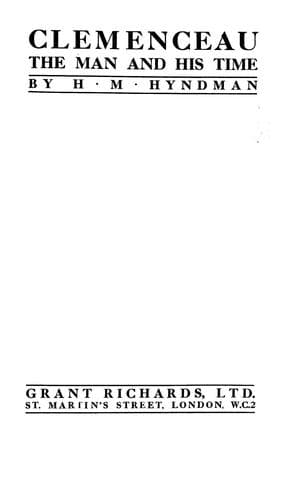
Clemenceau, the Man and His TimeHyndman, H. M. (Henry Mayers)
History
Clemenceau, the Man and His Time
Hyndman, H. M. (Henry Mayers)
Clemenceau, Georges, 1841-1929; France -- Politics and government -- 1870-1940
Clemenceau, therefore, from the moment when he gave up the Premiership,
lost no chance of inculcating the need for vigorous preparation. France
must be ready to meet a German assault by land and by sea. When the
time came she was not ready on either element, and without the help in
finance, in munitions, in clothing, and by arms, on land and on the
ocean, at once given by England--whom Clemenceau always upheld as the
friend of the Republic--France would have been overrun and crushed,
before she could possibly have obtained aid from elsewhere. In spite of
the Franco-German agreement of 1909, the danger of such an attack in
1911 was very great: so much so that war was then commonly expected,
and was only averted because Germany thought she would be in a more
commanding position to carry out her predetermined policy three or
four years later. The Franco-German Convention relating to Morocco, of
November 4th, 1911, after the Agadir difficulty, was no better than a
pretence. It was not intended, in good faith, to ensure a permanent
peace, so far as Germany was concerned. This Clemenceau felt sure of,
though the treaty was by no means unfavourable to France. He was ready
to make all sacrifices, however mortifying, provided only a genuine
treaty of peace and understanding between the two peoples could be
secured. But this must not be done blindly. It must be an integral part
of a serious national policy.
Therefore, speaking in the Senate on the 12th February, 1912, in
opposition to the treaty with Germany about Morocco, he went on: "We
shall make every effort to give fresh proofs of our goodwill--we have
given enough and to spare already during the past forty years--in order
that the consequences of this treaty may fructify under conditions
worthy of the dignity of the two peoples; but we must know what the
other party to the treaty is about, what are his intentions, what he
thinks, says, proposes to do, and what signs of goodwill _he_ likewise
has vouchsafed. That is the question we must have the courage to ask
ourselves. This question I deal with at my own risk and peril, without
being concerned as to what I have to say, because I have at heart no
bad feeling, no hatred, to use the right word, towards the German
people. I want no provocation; firmly resolved as I am to do nothing
to sacrifice a vestige, however trifling, of our capacity to win if
attacked, I am equally convinced that peace is not only desirable
but necessary for the development of French ideas in the domain of
civilisation. . . . The German people won two great victories which
changed the equilibrium of Europe, in 1866 and in 1870. . . . _We
then knew, we had the actual proof in our hands, that, if the enemy
had occupied Paris, the capital of France would have been reduced
to ashes._ Prince Bismarck, in reply to the expostulations of Jules
Favre, declared that the German troops must enter at one of the gates,
'because I do not wish, when I get home, that a man who has lost a
Public-domain text, read in full here on John Shaqi.
Reviews
Reviews
No reviews yet
Be the first to share your thoughts on this work.
Elsewhere in the archive
Join the Discussion
Join the discussion
Sign in to leave a comment or review.
Sign InorCreate an account