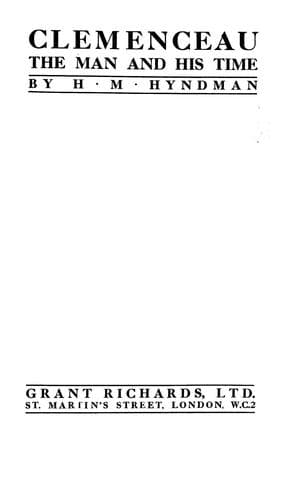
Clemenceau, the Man and His TimeHyndman, H. M. (Henry Mayers)
History
Clemenceau, the Man and His Time
Hyndman, H. M. (Henry Mayers)
Clemenceau, Georges, 1841-1929; France -- Politics and government -- 1870-1940
Clemenceau did what might have been expected of him. He appealed to
all Frenchmen of every shade of opinion to sink all minor differences
in one solid combination for the defence of the country. Day after
day, this powerful journalist and orator laboured to encourage
his countrymen and to denounce unceasingly all who, honestly or
dishonestly, stood in the way of the vigorous and successful
prosecution of the war which should free France for ever from yet
other attempts by Germany to destroy her as an independent nation.
The memory of the dark days of 1870 was obliterated by the horrors of
1914 onwards. In good and bad fortune the Radical leader kept the same
resolute attitude and used the like stirring language. _L'Homme Libre_,
defaced and then suppressed by the Censor, was succeeded by _L'Homme
Enchaîné_. Ever the same policy of relentless warfare, against the
enemy at the front, and the traitors at the rear, was steadily pursued.
Ministry might come, Ministry might go, but still Clemenceau was at his
post, save when illness compelled him to quit his work for a short time.
Nor did he waver in his views as to the general strategy to be pursued.
Without making any pretence to military knowledge, but well advised by
experts on military affairs, and firmly convinced that whatever success
Germany might achieve elsewhere she would never be satisfied unless
France was crushed, he persistently opposed diversion of strength from
the Western front. _There_ this terrific struggle for world-domination
would eventually be decided. The civilisation of the West must be
subdued to German culture, France and England must be brought under
German control, before the great programme of Eastern expansion for the
Teutonic Empire could be entered upon with the certainty of success.
These were the opinions he held as to Germany's real objects.
Therefore, in opposition to the views of important personages in Great
Britain and in Allied countries, Clemenceau withstood any frittering
away of force on tempting adventures, away from the main field of
warfare. This not because he confined himself to the narrow programme
of freeing France from the invaders, but because the waste of troops
on wild-cat enterprises weakened the general strength of the Allies at
the crucial point of the whole struggle. In that decision his judgment
was at one with the ablest British strategists, and the event has
shown that he did not underrate the importance of the warfare on the
Western front. There alone, especially after the collapse of Russia,
was it possible to deliver a crushing blow at the German power. There
alone could all the forces of the Allies of the West be effectively
concentrated for the final blow.
CHAPTER XVIII
THE GREAT WAR
Public-domain text, read in full here on John Shaqi.
Reviews
Reviews
No reviews yet
Be the first to share your thoughts on this work.
Elsewhere in the archive
Join the Discussion
Join the discussion
Sign in to leave a comment or review.
Sign InorCreate an account