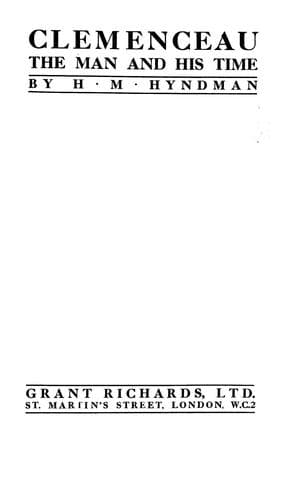
Clemenceau, the Man and His TimeHyndman, H. M. (Henry Mayers)
History
Clemenceau, the Man and His Time
Hyndman, H. M. (Henry Mayers)
Clemenceau, Georges, 1841-1929; France -- Politics and government -- 1870-1940
His energy and power of work were those of a vigorous young man in
the height of training. Starting for the front in a motor-car at four
or five o'clock in the morning at least three times a week, he kept
in touch with generals, officers and soldiers all along the lines
to an extent that would have seemed incredible if it had not been
actually done. Once at the front he walked about under fire as if he
had come out for the pleasure of risking his life with the _poilus_
who were fighting for La Patrie. Marshal Foch and Higher Command were
in constant fear for him. But he knew what he was about. Valuable as
his own life might be to the country, to court death was a higher duty
than to take care of himself, if by this seeming indifference he made
Frenchmen all along the trenches feel that he and they were one. He
succeeded. Fortune favoured him throughout. Then having discoursed
with the Marshal and his generals, having saluted and talked with the
officers, he chatted with the rank and file of the soldiery and rushed
back to Paris, arriving at the Ministry of War at ten or eleven o'clock
at night, ready to attend to such pressing business as demanded his
personal care. And all the time cheerful, alert, confident, showing,
when things looked dark, as when the great advance began, that the
Prime Minister of the Republic never for one moment doubted the Germans
would be hurled back over the frontier and France would again take her
rightful place in the world.
And that is not all. Clemenceau's influence in the Council Chamber of
the Allies was and is supreme. The old gaiety of heart remains, but
the soundness of judgment and determination to accept no compromise
of principle are more marked than ever. Many dangerous intrigues
during the past few months, of which the world has heard little, were
snuffed clean out by Clemenceau's force of character and overwhelming
personality. The French Prime Minister wanted final victory for France
and her Allies. Nothing short of this would satisfy him. There was
no personal loyalty he wished to build up, no political object that
he desired to attain, no section or party that he felt himself bound
to propitiate. Therefore the other Ministers of the Allies found
themselves at the table with a statesman who was something more than an
individual representative of his nation. He was the human embodiment of
a cause. What that meant and still means will only be known when the
dust of conflict has passed from us and the whole truth of Clemenceau's
policy can be told.
Public-domain text, read in full here on John Shaqi.
Reviews
Reviews
No reviews yet
Be the first to share your thoughts on this work.
Elsewhere in the archive
Join the Discussion
Join the discussion
Sign in to leave a comment or review.
Sign InorCreate an account