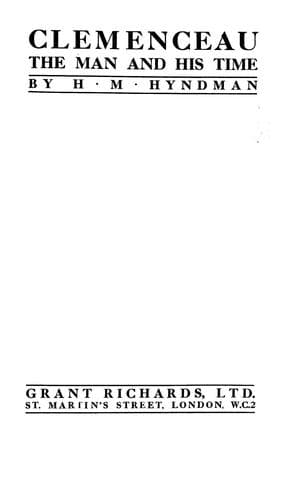
Clemenceau, the Man and His TimeHyndman, H. M. (Henry Mayers)
History
Clemenceau, the Man and His Time
Hyndman, H. M. (Henry Mayers)
Clemenceau, Georges, 1841-1929; France -- Politics and government -- 1870-1940
The statesman may quite honestly accept the theories of economists
and sociologists, while compelled to adapt their application to the
circumstances of his time. No really capable Socialist who has taken
an active part in public life has ever attempted to do anything else.
In France the Guesdists, who are certainly the most thoroughgoing
Marxists in the country, have always proceeded on these lines in their
municipal, and not unfrequently in their State, policy. Jaurès was a
specially fine example of the opportunist in public affairs; so much
so that he was taunted by more extreme men with being a Ministerialist
before he was a Minister. Vaillant the Blanquist, in theory at least an
advocate of a physical force revolution where possible, was in favour
of an eight-hour law, compensation for injury to workmen, and so on.
One and all, that is to say, were ready to use the social and political
forms of to-day in order to prepare the way for the complete revolution
tomorrow. All Clemenceau's speeches and writings, before and after the
Panama crash and its consequences to him, contain many passages which
every convinced Socialist would accept. I always felt, nevertheless,
that I was arguing with a man deaf of both ears when I put forward my
well-meant suggestions. Socialism, Clemenceau then declared--this,
of course, was now nearly a generation ago--would never become an
effective political power in France. France, and above all rural
France, which is the real France, constituting the bulk of Frenchmen,
is and will always remain steadfastly individualist--"founded on
property, property, property." That was their guiding principle in
every relation in life, and, he added, "I have seen them close at
every stage of existence from birth to death. It is as useless to base
any practical policy upon Socialist principles as it is chimerical to
repose any confidence in Socialist votes." "But," I urged, "extremes
meet: the Catholics and Socialists, both of whom are your opponents,
may combine with the men whose minds have been poisoned by the Panamist
and Anglophobe imputations of the _Petit Journal_ and turn you out
of your constituency in the Var for which you now sit as deputy." He
laughed at the very idea of such a defeat.
Public-domain text, read in full here on John Shaqi.
Reviews
Reviews
No reviews yet
Be the first to share your thoughts on this work.
Elsewhere in the archive
Join the Discussion
Join the discussion
Sign in to leave a comment or review.
Sign InorCreate an account