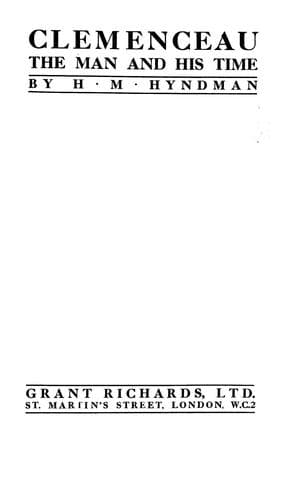
Clemenceau, the Man and His TimeHyndman, H. M. (Henry Mayers)
History
Clemenceau, the Man and His Time
Hyndman, H. M. (Henry Mayers)
Clemenceau, Georges, 1841-1929; France -- Politics and government -- 1870-1940
Clemenceau at this period was fifty-two, and still in the prime
of a vigorous life. He looked what he was, active, alert, capable
and highly intelligent. His face was an index to his character. It
gave an impression of almost barbarous energy, which induced his
Socialist detractors, long afterwards, to speak and write of him as
"The Kalmuck." But this was merely caricature. Refinement, mental
brilliancy, deep reflection and high cultivation shone out from his
animated features. A teetotaller, abstemious in his habits, and
always in training, Clemenceau, with his rapidity of perception,
quickness of retort and mastery of irony combined with trenchant wit,
was a formidable opponent indeed. Add to this that he was invariably
well-informed--_très bien documenté_--in the matters of which he
treated. It is quite inconceivable that he should refer to or deal
with any speech, or convention, or treaty which he had not thoroughly
studied. It was hopeless to catch Clemenceau tripping on any matter of
fact or political engagement. Moreover, as remarked before, his rule in
politics was based upon the soundest principle in all warfare: Never
fail to attack in order to defend.
As an orator he was and is destitute of those telling gestures,
modifications of tone and carefully turned phrases which we associate
with the highest class of French public speaking. His voice rarely
rises above the conversational level and, as a rule, he is quiet and
unemotional in his manner. But the directness of his assaults and the
dynamitical force of his short periods gain rather than lose on that
account; while his power of logical, connected argument, marshalling
with ease such facts and quotations as he needs, has never been
surpassed. His famous Parliamentary encounter with my friend and
comrade Jean Jaurès was a remarkable example of his controversial
ability. My sympathies were, of course, entirely with the eloquent
and able champion of Socialism, whose power of holding even a hostile
audience was extraordinary, as was shown in that same National
Assembly many a time. I was of opinion then, and I believe now, that
Jaurès had much the stronger case. He spoke then, as he always did,
with eloquence, fervour and sincerity. As an oratorical display it
was admirable. But I am bound to admit that, as a mere question of
immediate political dialectics, the Radical Premier got the better
of the fray. It is possible, of course, that had Jaurès followed
Clemenceau instead of having preceded him, that might have made a
difference. But Jaurès's style, with its poetic elevation and long and
imposing periods, was not so well suited as that of Clemenceau to a
personal debate on immediate practical issues before such an audience
as the French National Assembly.
Public-domain text, read in full here on John Shaqi.
Reviews
Reviews
No reviews yet
Be the first to share your thoughts on this work.
Elsewhere in the archive
Join the Discussion
Join the discussion
Sign in to leave a comment or review.
Sign InorCreate an account