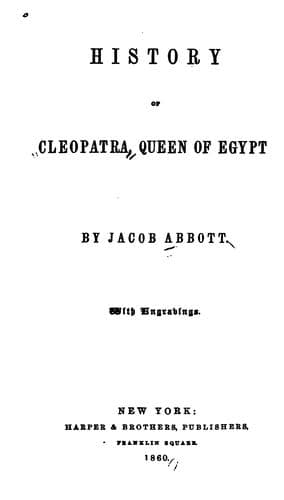
Cleopatra, Queen of Egypt, -30 B.C.; Egypt -- History -- 332-30 B.C. -- Biography; Queens -- Egypt -- Biography
After the battle of Philippi, described in the last chapter,
Antony--who, with all his faults, was sometimes a very generous foe--as
soon as the tidings of Brutus's death were brought to him, repaired
immediately to the spot, and appeared to be quite shocked and concerned
at the sight of the body. He took off his own military cloak or
mantle--which was a very magnificent and costly garment, being enriched
with many expensive ornaments--and spread it over the corpse. He then
gave directions to one of the officers of his household to make
arrangements for funeral ceremonies of a very imposing character, as a
testimony of his respect for the memory of the deceased. In these
ceremonies it was the duty of the officer to have burned the military
cloak which Antony had appropriated to the purpose of a pall, with the
body. He did not, however, do so. The cloak being very valuable, he
reserved it; and he withheld, also, a considerable part of the money
which had been given him for the expenses of the funeral. He supposed
that Antony would probably not inquire very closely into the details of
the arrangements made for the funeral of his most inveterate enemy.
Antony, however, did inquire into them, and when he learned what the
officer had done, he ordered him to be killed.
The various political changes which occurred, and the movements which
took place among the several armies after the battle of Philippi, can
not be here detailed. It is sufficient to say that Antony proceeded to
the eastward through Asia Minor, and in the course of the following year
came into Cilicia. From this place he sent a messenger to Egypt to
Cleopatra, summoning her to appear before him. There were charges, he
said, against her of having aided Cassius and Brutus in the late war
instead of rendering assistance to him. Whether there really were any
such charges, or whether they were only fabricated by Antony as pretexts
for seeing Cleopatra, the fame of whose beauty was very widely extended,
does not certainly appear. However this may be, he sent to summon the
queen to come to him. The name of the messenger whom Antony dispatched
on this errand was Dellius. Fulvia, Antony's wife, was not with him at
this time. She had been left behind at Rome.
Public-domain text, read in full here on John Shaqi.
Reviews
Reviews
No reviews yet
Be the first to share your thoughts on this work.
Elsewhere in the archive
Join the Discussion
Join the discussion
Sign in to leave a comment or review.
Sign InorCreate an account