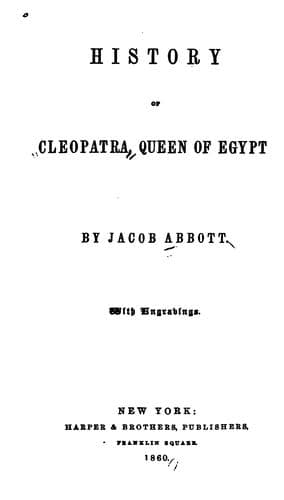
Cleopatra, Queen of Egypt, -30 B.C.; Egypt -- History -- 332-30 B.C. -- Biography; Queens -- Egypt -- Biography
Antony was not entirely at ease, however, during the progress
of these terrible experiments. His foolish and childish fondness
for Cleopatra was mingled with jealousy, suspicion, and distrust;
and he was so afraid that Cleopatra might secretly poison him,
that he would never take any food or wine without requiring that she
should taste it before him. At length, one day, Cleopatra caused the
petals of some flowers to be poisoned, and then had the flowers woven
into the chaplet which Antony was to wear at supper. In the midst of the
feast, she pulled off the leaves of the flowers from her own chaplet and
put them playfully into her wine, and then proposed that Antony should
do the same with his chaplet, and that they should then drink the wine,
tinctured, as it would be, with the color and the perfume of the
flowers. Antony entered very readily into this proposal, and when he was
about to drink the wine, she arrested his hand, and told him that it was
poisoned. "You see now," said she, "how vain it is for you to watch
against me. If it were possible for me to live without you, how easy it
would be for me to devise ways and means to kill you." Then, to prove
that her words were true, she ordered one of the servants to drink
Antony's wine. He did so, and died before their sight in dreadful agony.
The experiments which Cleopatra thus made on the nature and effects of
poison were not, however, wholly without practical result. Cleopatra
learned from them, it is said, that the bite of the asp was the easiest
and least painful mode of death. The effect of the venom of that animal
appeared to her to be the lulling of the sensorium into a lethargy or
stupor, which soon ended in death, without the intervention of pain.
This knowledge she seems to have laid up in her mind for future use.
The thoughts of Cleopatra appear, in fact, to have been much disposed,
at this time, to flow in gloomy channels, for she occupied herself a
great deal in building for herself a sepulchral monument in a certain
sacred portion of the city. This monument had, in fact, been commenced
many years ago, in accordance with a custom prevailing among Egyptian
sovereigns, of expending a portion of their revenues during their
life-time in building and decorating their own tombs. Cleopatra now
turned her mind with new interest to her own mausoleum. She finished it,
provided it with the strongest possible bolts and bars, and, in a word,
seemed to be preparing it in all respects for occupation.
Public-domain text, read in full here on John Shaqi.
Reviews
Reviews
No reviews yet
Be the first to share your thoughts on this work.
Elsewhere in the archive
Join the Discussion
Join the discussion
Sign in to leave a comment or review.
Sign InorCreate an account