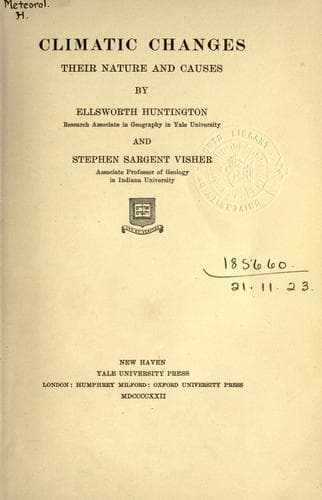
Climatic Changes: Their Nature and CausesHuntington, Ellsworth
Science
Climatic Changes: Their Nature and Causes
Huntington, Ellsworth
Climatic changes; Climatology; Paleoclimatology
In this connection it may be well to consider briefly the most recent
hypothesis as to the growth and hence the localization of glaciation. In
1911 and more fully in 1915, Hobbs,[46] advanced the anti-cyclonic
hypothesis of the origin of ice sheets. This hypothesis has the great
merit of focusing attention upon the fact that ice sheets are pronounced
anti-cyclonic regions of high pressure. This is proved by the strong
outblowing winds which prevail along their margins. Such winds must, of
course, be balanced by inward-moving winds at high levels. Abundant
observations prove that such is the case. For example, balloons sent up
by Barkow near the margin of the Antarctic ice sheet reveal the
occurrence of inblowing winds, although they rarely occur below a height
of 9000 meters. The abundant data gathered by Guervain on the coast of
Greenland indicate that outblowing winds prevail up to a height of about
4000 meters. At that height inblowing winds commence and increase in
frequency until at an altitude of over 5000 meters they become more
common than outblowing winds. It should be noted, however, that in both
Antarctica and Greenland, although the winds at an elevation of less
than a thousand meters generally blow outward, there are frequent and
decided departures from this rule, so that "variable winds" are quite
commonly mentioned in the reports of expeditions and balloon soundings.
The undoubted anti-cyclonic conditions which Hobbs thus calls to the
attention of scientists seem to him to necessitate a peculiar mechanism
in order to produce the snow which feeds the glaciers. He assumes that
the winds which blow toward the centers of the ice sheets at high levels
carry the necessary moisture by which the glaciers grow. When the air
descends in the centers of the highs, it is supposed to be chilled on
reaching the surface of the ice, and hence to give up its moisture in
the form of minute crystals. This conclusion is doubtful for several
reasons. In the first place, Hobbs does not seem to appreciate the
importance of the variable winds which he quotes Arctic and Antarctic
explorers as describing quite frequently on the edges of the ice sheets.
They are one of many signs that cyclonic storms are fairly frequent on
the borders of the ice though not in its interior. Thus there is a
distinct and sufficient form of precipitation actually at work near the
margin of the ice, or exactly where the thickness of the ice sheet would
lead us to expect.
Public-domain text, read in full here on John Shaqi.
Reviews
Reviews
No reviews yet
Be the first to share your thoughts on this work.
Elsewhere in the archive
Join the Discussion
Join the discussion
Sign in to leave a comment or review.
Sign InorCreate an account