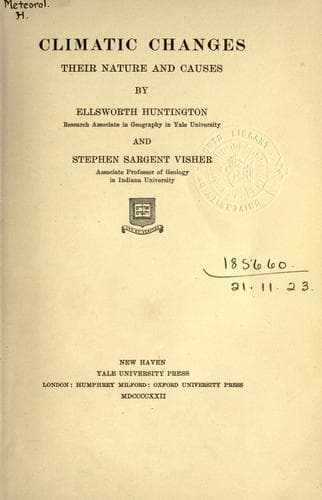
Climatic Changes: Their Nature and CausesHuntington, Ellsworth
Science
Climatic Changes: Their Nature and Causes
Huntington, Ellsworth
Climatic changes; Climatology; Paleoclimatology
Nevertheless it is not yet possible to determine how warm the oceans
were at the actual time of the Permian glaciation. Some faunas formerly
reported as Permian are now known to be considerably older. Moreover,
others of undoubted Permian age are probably not strictly
contemporaneous with the glaciation. So far back in the geological
record it is very doubtful whether we can date fossils within the limits
of say 100,000 years. Yet a difference of 100,000 years would be more
than enough to allow the fossils to have lived either before or after
the glaciation, or in an inter-glacial epoch. One such epoch is known to
have occurred and nine others are suggested by the inter-stratification
of glacial till and marine sediments in eastern Australia. The warm
currents which would flow poleward in inter-glacial epochs must have
favored a prompt reintroduction of marine faunas driven out during times
of glaciation. Taken all and all, the Permian glaciation seems to be
accounted for by the cyclonic hypothesis quite as well as does the
Pleistocene. In both these cases, as well as in the various pulsations
of historic times, it seems to be necessary merely to magnify what is
happening today in order to reproduce the conditions which prevailed in
the past. If the conditions which now prevail at times of sunspot minima
were magnified, they would give the mild conditions of inter-glacial
epochs and similar periods. If the conditions which now prevail at times
of sunspot maxima are magnified a little they seem to produce periods of
climatic stress such as those of the fourteenth century. If they are
magnified still more the result is apparently glacial epochs like those
of the Pleistocene, and if they are magnified to a still greater extent,
the result is Permian or Proterozoic glaciation. Other factors must
indeed be favorable, for climatic changes are highly complex and are
unquestionably due to a combination of circumstances. The point which is
chiefly emphasized in this book is that among those several
circumstances, changes in cyclonic storms due apparently to activity of
the sun's atmosphere must always be reckoned.
FOOTNOTES:
[Footnote 46: W. H. Hobbs: Characteristics of Existing Glaciers, 1911.
The Role of the Glacial Anticyclones in the Air Circulation of the
Globe; Proc. Am. Phil. Soc., Vol. 54, 1915, pp. 185-225.]
[Footnote 47: R. D. Salisbury: Physiography, 1919.]
[Footnote 48: Griffith Taylor: Australian Meteorology, 1920, p. 283.]
[Footnote 49: J. D. Whitney: Climatic Changes of the Later Geological
Times, 1882.]
[Footnote 50: E. E. Free: U. S. Dept. of Agriculture, Bull. 54, 1914.
Mr. Free has prepared a summary of this Bulletin which appears in The
Solar Hypothesis, Bull. Geol. Sec. of Am., Vol. 25, pp. 559-562.]
[Footnote 51: G. K. Gilbert: Lake Bonneville; Monograph 1, U. S. Geol.
Surv.]
[Footnote 52: C. E. P. Brooks: Quart. Jour. Royal Meteorol. Soc., 1914,
pp. 63-66.]
Public-domain text, read in full here on John Shaqi.
Reviews
Reviews
No reviews yet
Be the first to share your thoughts on this work.
Elsewhere in the archive
Join the Discussion
Join the discussion
Sign in to leave a comment or review.
Sign InorCreate an account