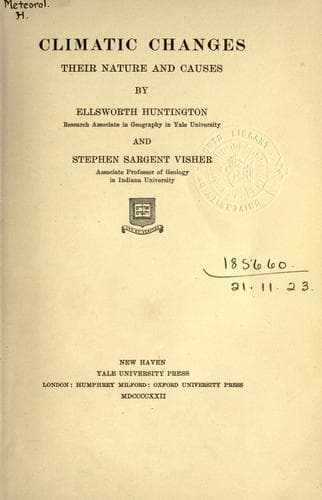
Climatic Changes: Their Nature and CausesHuntington, Ellsworth
Science
Climatic Changes: Their Nature and Causes
Huntington, Ellsworth
Climatic changes; Climatology; Paleoclimatology
(a) At present the westward drift of warm waters, set in motion by the
trade winds, is interrupted by land masses and turned poleward,
producing the important Gulf Stream Drift and Japan Current in the
northern hemisphere, and corresponding, though less important, currents
in the southern hemisphere. During the past, quite different sets of
ocean currents doubtless have existed in response to a different
distribution of land. Repeatedly, in the mid-Cretaceous (Fig. 9) and
several other periods, the present American barrier to the westward
moving tropical current was broken in Central America. Even if the
supposed continent of "Gondwana Land" extended from Africa to South
America in equatorial latitudes, strong currents must still have flowed
westward along its northern shore under the impulse of the peculiarly
strong trade winds which the equatorial land would create. Nevertheless
at such times relatively little warm tropical water presumably entered
the North Atlantic, for it escaped into the Pacific. At several other
times, such as the late Ordovician and mid-Devonian, when the isthmian
barrier existed, it probably turned an important current northward into
what is now the Mississippi Basin instead of into the Atlantic. There it
traversed an epeiric, or mid-continental sea open to both north and
south. Hence its effectiveness in warming Arctic regions must have been
quite different from that of the present Gulf Stream.
(b) We will next consider the influences of changes in the amount of
equatorial and tropical land. As such lands are much hotter than the
corresponding seas, the intensity and width of the equatorial belt of
low pressure must be great when they are extensive. Hence the trade
winds must have been stronger than now whenever tropical lands were more
extensive than at present. This is because the trades are produced by
the convection due to excessive heat along the heat equator. There the
air expands upward and flows poleward at high altitudes. The trade wind
consists of air moving toward the heat equator to take the place of the
air which there rises. When the lands in low latitudes were wide the
trade winds must also have dominated a wide belt. The greater width of
the trade-wind belt today over Africa than over the Atlantic illustrates
the matter. The belt must have been still wider when Gondwana Land was
large, as it is believed to have been during the Paleozoic era and the
early Mesozoic.
Public-domain text, read in full here on John Shaqi.
Reviews
Reviews
No reviews yet
Be the first to share your thoughts on this work.
Elsewhere in the archive
Join the Discussion
Join the discussion
Sign in to leave a comment or review.
Sign InorCreate an account