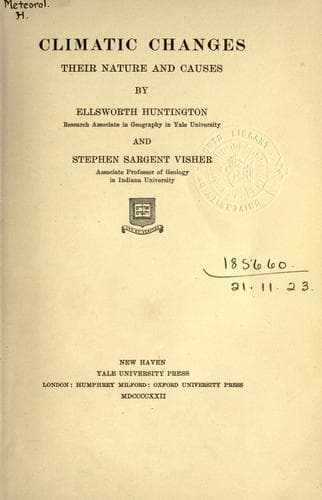
Climatic Changes: Their Nature and CausesHuntington, Ellsworth
Science
Climatic Changes: Their Nature and Causes
Huntington, Ellsworth
Climatic changes; Climatology; Paleoclimatology
The whole relationship between earthquakes and the seasons in the
northern and southern hemispheres is summed up in Fig. 12 taken from
Knott. The northern hemisphere shows a regular diminution in earthquake
frequency from December until June, and an increase the rest of the
year. In the southern hemisphere the course of events is the same so far
as summer and winter are concerned, for August with its maximum comes in
winter, while February with its minimum comes in summer. In the southern
hemisphere the winter month of greatest seismic activity has over 100
per cent more earthquakes than the summer month of least activity. In
the northern hemisphere this difference is about 80 per cent, but this
smaller figure occurs partly because the northern data include certain
interesting and significant regions like Japan and China where the usual
conditions are reversed.[131] If equatorial regions were included in
Fig. 12, they would give an almost straight line.
The connection between earthquakes and the seasons is so strong that
almost no students of seismology question it, although they do not agree
as to its cause. A meteorological hypothesis seems to be the only
logical explanation.[132] Wherever sufficient data are available,
earthquakes appear to be most numerous when climatic conditions cause
the earth's surface to be most heavily loaded or to change its load most
rapidly. The main factor in the loading is apparently atmospheric
pressure. This acts in two ways. First, when the continents become cold
in winter the pressure increases. On an average the air at sea level
presses upon the earth's surface at the rate of 14.7 pounds per square
inch, or over a ton per square foot, and only a little short of thirty
million tons per square mile. An average difference of one inch between
the atmospheric pressure of summer and winter over ten million square
miles of the continent of Asia, for example, means that the continent's
load in winter is about ten million million tons heavier than in summer.
Second, the changes in atmospheric pressure due to the passage of storms
are relatively sharp and sudden. Hence they are probably more effective
than the variations in the load from season to season. This is suggested
by the rapidity with which the terrestrial response seems to follow the
supposed solar cause of earthquakes. It is also suggested by the fact
that violent storms are frequently followed by violent earthquakes.
"Earthquake weather," as Dr. Schlesinger suggests, is a common phrase in
the typhoon region of Japan, China, and the East Indies. During tropical
hurricanes a change of pressure amounting to half an inch in two hours
is common. On September 22, 1885, at False Point Lighthouse on the Bay
of Bengal, the barometer fell about an inch in six hours, then nearly an
inch and a half in not much over two hours, and finally rose fully two
inches inside of two hours. A drop of two inches in barometric pressure
Public-domain text, read in full here on John Shaqi.
Reviews
Reviews
No reviews yet
Be the first to share your thoughts on this work.
Elsewhere in the archive
Join the Discussion
Join the discussion
Sign in to leave a comment or review.
Sign InorCreate an account