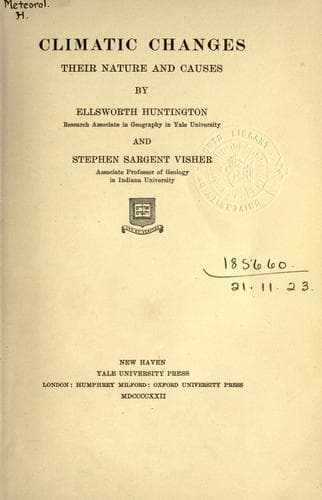
Climatic Changes: Their Nature and CausesHuntington, Ellsworth
Science
Climatic Changes: Their Nature and Causes
Huntington, Ellsworth
Climatic changes; Climatology; Paleoclimatology
Here we must bring this study of the earth's evolution to a close. Its
fundamental principle has been that the present, if rightly understood,
affords a full key to the past. With this as a guide we have touched on
many hypotheses, some essential and some unessential to the general line
of thought. The first main hypothesis is that the earth's present
climatic variations are correlated with changes in the solar atmosphere.
This is the keynote of the whole book. It is so well established,
however, that it ranks as a theory rather than as an hypothesis. Next
comes the hypothesis that variations in the solar atmosphere influence
the earth's climate chiefly by causing variations not only in
temperature but also in atmospheric pressure and thus in storminess,
wind, and rainfall. This, too, is one of the essential foundations on
which the rest of the book is built, but though this cyclonic hypothesis
is still a matter of discussion, it seems to be based on strong
evidence. These two hypotheses might lead us astray were they not
balanced by another. This other is that many climatic conditions are due
to purely terrestrial causes, such as the form and altitude of the
lands, the degree to which the continents are united, the movement of
ocean currents, the activity of volcanoes, and the composition of the
atmosphere and the ocean. Only by combining the solar and the
terrestrial can the truth be perceived. Finally, the last main
hypothesis of this book holds that if the climatic conditions which now
prevail at times of solar activity were magnified sufficiently and if
they occurred in conjunction with certain important terrestrial
conditions of which there is good evidence, they would produce most of
the notable phenomena of glacial periods. For example, they would
explain such puzzling conditions as the localization and periodicity of
glaciation, the formation of loess, and the occurrence of glaciation in
low latitudes during Permian and Proterozoic times. The converse of this
is that if the conditions which now prevail at times when the sun is
relatively inactive should be intensified, that is, if the sun's
atmosphere should become calmer than now, and if the proper terrestrial
conditions of topographic form and atmospheric composition should
prevail, there would arise the mild climatic conditions which appear to
have prevailed during the greater part of geological time. In short,
there seems thus far to be no phase of the climate of the past which is
not in harmony with an hypothesis which combines into a single unit the
three main hypotheses of this book, solar, cyclonic, and terrestrial.
Public-domain text, read in full here on John Shaqi.
Reviews
Reviews
No reviews yet
Be the first to share your thoughts on this work.
Elsewhere in the archive
Join the Discussion
Join the discussion
Sign in to leave a comment or review.
Sign InorCreate an account