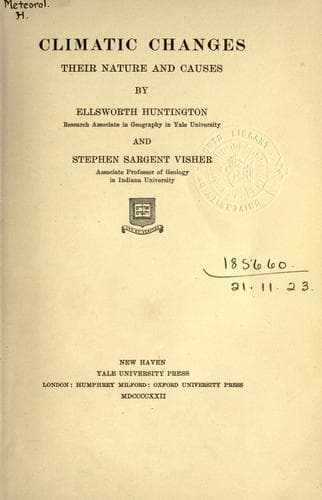
Climatic Changes: Their Nature and CausesHuntington, Ellsworth
Science
Climatic Changes: Their Nature and Causes
Huntington, Ellsworth
Climatic changes; Climatology; Paleoclimatology
In the main Gregory's conclusions seem to be well grounded, although
even according to his data a change of 2 deg. or 3 deg. in mean temperature
would be perfectly feasible. It will be noticed, however, that they
apply to temperature and not to rainfall. They merely prove that two
thousand years ago the mean temperature of Palestine and the neighboring
regions was not appreciably different from what it is today. This,
however, is in no sense out of harmony with the hypothesis of climatic
pulsations. Students of glaciation believe that during the last glacial
epoch the mean temperature of the earth as a whole was only 5 deg. or 6 deg.C.
lower than at present. If the difference between the climate of today
and of the time of Christ is a tenth as great as the difference between
the climate of today and that which prevailed at the culmination of the
last glacial epoch, the change in two thousand years has been of large
dimensions. Yet this would require a rise of only half a degree
Centigrade in the mean temperature of Palestine. Manifestly, so slight a
change would scarcely be detectable in the vegetation.
The slightness of changes in mean temperature as compared with changes
in rainfall may be judged from a comparison of wet and dry years in
various regions. For example, at Berlin between 1866 and 1905 the ten
most rainy years had an average precipitation of 670 mm. and a mean
temperature of 9.15 deg.C. On the other hand, the ten years of least
rainfall had an average of 483 mm. and a mean temperature of 9.35 deg.. In
other words, a difference of 137 mm., or 39 per cent, in rainfall was
accompanied by a difference of only 0.2 deg.C. in temperature. Such
contrasts between the variability of mean rainfall and mean temperature
are observable not only when individual years are selected, but when
much longer periods are taken. For instance, in the western Gulf region
of the United States the two inland stations of Vicksburg, Mississippi,
and Shreveport, Louisiana, and the two maritime stations of New Orleans,
Louisiana, and Galveston, Texas, lie at the margins of an area about 400
miles long. During the ten years from 1875 to 1884 their rainfall
averaged 59.4 inches,[30] while during the ten years from 1890 to 1899
it averaged only 42.4 inches. Even in a region so well watered as the
Gulf States, such a change--40 per cent more in the first decade than in
the second--is important, and in drier regions it would have a great
effect on habitability. Yet in spite of the magnitude of the change the
mean temperature was not appreciably different, the average for the four
stations being 67.36 deg.F. during the more rainy decade and 66.94 deg.F. during
the less rainy decade--a difference of only 0.42 deg.F. It is worth noticing
that in this case the wetter period was also the warmer, whereas in
Berlin it was the cooler. This is probably because a large part of the
moisture of the Gulf States is brought by winds having a southerly
component.
Public-domain text, read in full here on John Shaqi.
Reviews
Reviews
No reviews yet
Be the first to share your thoughts on this work.
Elsewhere in the archive
Join the Discussion
Join the discussion
Sign in to leave a comment or review.
Sign InorCreate an account