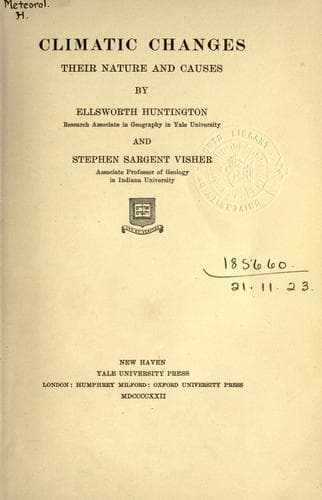
Climatic Changes: Their Nature and CausesHuntington, Ellsworth
Science
Climatic Changes: Their Nature and Causes
Huntington, Ellsworth
Climatic changes; Climatology; Paleoclimatology
Similar relationships are apparent in other places. We select
Jerusalem because we have been discussing Palestine. At the time of
writing, the data available in the _Quarterly Journal of the Palestine
Exploration Fund_ cover the years from 1882-1899 and 1903-1909. Among
these twenty-five years the thirteen which had most rain had an average
of 34.1 inches and a temperature of 62.04 deg.F. The twelve with least rain
had 24.4 inches and a temperature of 62.44 deg.. A difference of 40 per cent
in rainfall was accompanied by a difference of only 0.4 deg.F. in
temperature.
The facts set forth in the preceding paragraphs seem to show that
extensive changes in precipitation and storminess can take place without
appreciable changes of mean temperature. If such changed conditions can
persist for ten years, as in one of our examples, there is no logical
reason why they cannot persist for a hundred or a thousand. The evidence
of changes in climate during the historic period seems to suggest
changes in precipitation much more than in temperature. Hence the
strongest of all the arguments against historic changes of climate seems
to be of relatively little weight, and the pulsatory hypothesis seems to
be in accord with all the known facts.
Before the true nature of climatic changes, whether historic or
geologic, can be rightly understood, another point needs emphasis. When
the pulsatory hypothesis was first framed, it fell into the same error
as the hypotheses of uniformity and of progressive change--that is, the
assumption was made that the whole world is either growing drier or
moister with each pulsation. A study of the ruins of Yucatan, in 1912,
and of Guatemala, in 1913, as is explained in _The Climatic Factor_, has
led to the conclusion that the climate of those regions has changed in
the opposite way from the changes which appear to have taken place in
the desert regions farther south. These Maya ruins in Central America
are in many cases located in regions of such heavy rainfall, such dense
forests, and such malignant fevers that habitation is now practically
impossible. The land cannot be cultivated except in especially favorable
places. The people are terribly weakened by disease and are among the
lowest in Central America. Only a hundred miles from the unhealthful
forests we find healthful areas, such as the coasts of Yucatan and the
plateau of Guatemala. Here the vast majority of the population is
gathered, the large towns are located, and the only progressive people
are found. Nevertheless, in the past the region of the forests was the
home of by far the most progressive people who are ever known to have
lived in America previous to the days of Columbus. They alone brought to
high perfection the art of sculpture; they were the only American people
who invented the art of writing. It seems scarcely credible that such a
people would have lived in the worst possible habitat when far more
favored regions were close at hand.
Public-domain text, read in full here on John Shaqi.
Reviews
Reviews
No reviews yet
Be the first to share your thoughts on this work.
Elsewhere in the archive
Join the Discussion
Join the discussion
Sign in to leave a comment or review.
Sign InorCreate an account