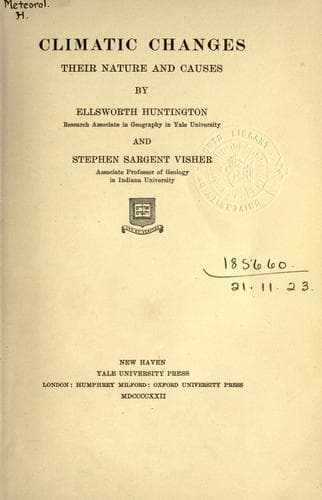
Climatic Changes: Their Nature and CausesHuntington, Ellsworth
Science
Climatic Changes: Their Nature and Causes
Huntington, Ellsworth
Climatic changes; Climatology; Paleoclimatology
The first [is] the great storm-floods on the coast of the North Sea
and the Baltic, which occurred so frequently that not less than
nineteen floods of a destructiveness unparalleled in later times are
recorded from the 14th century. The coastline of the North Sea was
completely altered by these floods. Thus on January 16, 1300, half
of the island Heligoland and many other islands were engulfed by the
sea. The same fate overtook the island of Borkum, torn into several
islands by the storm-flood of January 16, which remoulded the
Frisian Islands into their present shape, when also Wendingstadt, on
the island of Sylt, and Thiryu parishes were engulfed. This flood is
known under the name of "the great man-drowning." The coasts of the
Baltic also were exposed to storm-floods of unparalleled violence.
On November 1, 1304, the island of Ruden was torn asunder from Rugen
by the force of the waves. Time does not allow me to dwell upon
individual disasters of this kind, but it will be well to note that
of the nineteen great floods on record eighteen occurred in the cold
season between the autumnal and vernal equinoxes.
The second remarkable phenomenon mentioned by the chronicles is the
freezing of the entire Baltic, which occurred many times during the
cold winters of these centuries. On such occasions it was possible
to travel with carriages over the ice from Sweden to Bornholm and
from Denmark to the German coast (Lubeck), and in some cases even
from Gotland to the coast of Estland.
Norlind[32] says that "the only authentic accounts" of the complete
freezing of the Baltic in the neighborhood of the Kattegat are in the
years 1296, 1306, 1323, and 1408. Of these 1296 is "much the most
uncertain," while 1323 was the coldest year ever recorded, as appears
from the fact that horses and sleighs crossed regularly from Sweden to
Germany on the ice.
Not only central Europe and the shores of the North Sea were marked by
climatic stress during the fourteenth century, but Scandinavia also
suffered. As Pettersson puts it:
Public-domain text, read in full here on John Shaqi.
Reviews
Reviews
No reviews yet
Be the first to share your thoughts on this work.
Elsewhere in the archive
Join the Discussion
Join the discussion
Sign in to leave a comment or review.
Sign InorCreate an account