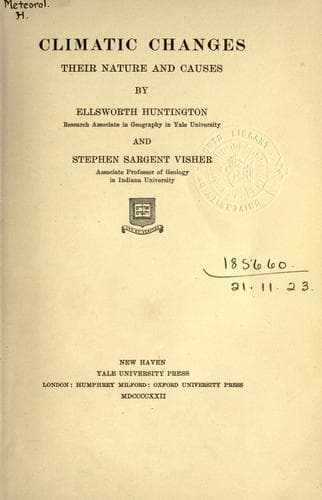
Climatic Changes: Their Nature and CausesHuntington, Ellsworth
Science
Climatic Changes: Their Nature and Causes
Huntington, Ellsworth
Climatic changes; Climatology; Paleoclimatology
On examining the historic (data) from the last centuries of the
Middle Ages, Dr. Bull of Christiania has come to the conclusion that
the decay of the Norwegian kingdom was not so much a consequence of
the political conditions at that time, as of the frequent failures
of the harvest so that corn [wheat] for bread had to be imported
from Luebeck, Rostock, Wismar and so forth. The Hansa Union undertook
the importation and obtained political power by its economic
influence. The Norwegian land-owners were forced to lower their
rents. The population decreased and became impoverished. The revenue
sank 60 to 70 per cent. Even the income from Church property
decreased. In 1367 corn was imported from Luebeck to a value of
one-half million kroner. The trade balance inclined to the
disadvantage of Norway whose sole article of export at that time
was dried fish. (The production of fish increased enormously in
the Baltic regions off south Sweden because of the same changes
which were influencing the lands, but this did not benefit
Norway.) Dr. Bull draws a comparison with the conditions described
in the Sagas when Nordland [at the Arctic Circle] produced enough
corn to feed the inhabitants of the country. At the time of
Asbjoern Selsbane the chieftains in Trondhenaes [still farther north
in latitude 69 deg.] grew so much corn that they did not need to go
southward to buy corn unless three successive years of dearth had
occurred. The province of Trondheim exported wheat to Iceland and
so forth. Probably the turbulent political state of Scandinavia at
the end of the Middle Ages was in a great measure due to
unfavorable climatic conditions, which lowered the standard of
life, and not entirely to misgovernment and political strife as
has hitherto been taken for granted.
Public-domain text, read in full here on John Shaqi.
Reviews
Reviews
No reviews yet
Be the first to share your thoughts on this work.
Elsewhere in the archive
Join the Discussion
Join the discussion
Sign in to leave a comment or review.
Sign InorCreate an account