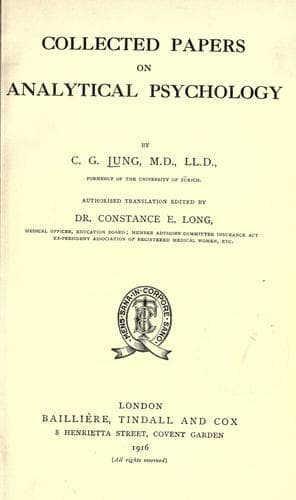
Collected Papers on Analytical PsychologyJung, C. G. (Carl Gustav)
Science
Collected Papers on Analytical Psychology
Jung, C. G. (Carl Gustav)
Psychoanalysis
All depends on how the test-person reacts to this situation. The word
"bride" or "bridegroom" will not evoke a simple reaction in a young
lady; but the reaction will be deeply influenced by the strong feeling
tones evoked, the more so if the experimenter be a man. It thus happens
that the test-person is often unable to react quickly and smoothly
to all stimulus words. There are certain stimulus words which denote
actions, situations, or things, about which the test-person cannot think
quickly and surely, and this fact is demonstrated in the association
experiments. The examples which I have just given show an abundance of
long reaction times and other disturbances. In this case the reaction
to the stimulus word is in some way impeded, that is, the adaptation to
the stimulus word is disturbed. The stimulus words therefore act upon us
just as reality acts; indeed, a person who shows such great disturbances
to the stimulus words, is in a certain sense but imperfectly adapted to
reality. Disease itself is an imperfect adaptation; hence in this case
we are dealing with something morbid in the psyche,--with something
which is either temporarily or persistently pathological in character,
that is, we are dealing with a psychoneurosis, with a functional
disturbance of the mind. This rule, however, as we shall see later, is
not without its exceptions.
Let us, in the first place, continue the discussion concerning the
prolonged reaction time. It often happens that the test-person actually
does _not_ know what to answer to the stimulus word. He waives any
reaction, and for the moment he totally fails to obey the original
instructions, and shows himself incapable of adapting himself to the
experimenter. If this phenomenon occurs frequently in an experiment,
it signifies a high degree of disturbance in adjustment. I would
call attention to the fact that it is quite indifferent what reason
the test-person gives for the refusal. Some find that too many ideas
suddenly occur to them; others, that they suffer from a deficiency of
ideas. In most cases, however, the difficulties first perceived are so
deterrent that they actually give up the whole reaction. The following
example shows a case of hysteria with many failures of reaction:--
Public-domain text, read in full here on John Shaqi.
Reviews
Reviews
No reviews yet
Be the first to share your thoughts on this work.
Elsewhere in the archive
Join the Discussion
Join the discussion
Sign in to leave a comment or review.
Sign InorCreate an account