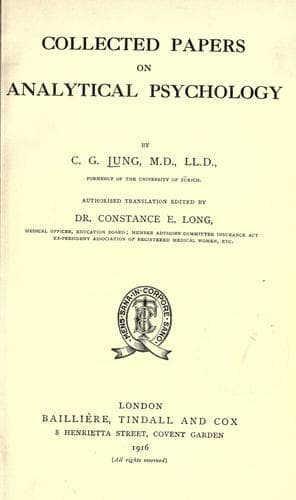
Collected Papers on Analytical PsychologyJung, C. G. (Carl Gustav)
Science
Collected Papers on Analytical Psychology
Jung, C. G. (Carl Gustav)
Psychoanalysis
After this preparatory work I undertook the experiment with the three
above-mentioned nurses. Following the order of the experiment, I shall
denote the friend of the head nurse by the letter A, the head nurse
by B, and the nurse who attended to the cleaning of the room by C. As
examinations of this kind can be rendered into a foreign tongue only
with the greatest difficulty, I will content myself with presenting the
general results, and with giving some examples. I first undertook the
experiment with A, and judging by the circumstances she appeared only
slightly moved. B was next examined; she showed marked excitement, her
pulse being 120 per minute immediately after the experiment. The last to
be examined was C. She was the most tranquil of the three; she displayed
but little embarrassment, and only in the course of the experiment
did it occur to her that she was suspected of stealing, a fact which
manifestly disturbed her towards the end of the experiment.
The general impression from the examination spoke strongly against the
head nurse B. It seemed to me that she evinced a very "suspicious," or
I might almost say, "impudent" countenance. With the definite idea of
finding in her the guilty one I set about adding up the results. You
will see that I was wrong in my surmise and that the test proved my
error.
One can make use of many special methods of computing, but they are
not all equally good and equally exact. (One must always resort to
calculation, as appearances are enormously deceptive.) The method
which is most to be recommended is that of the probable average of the
reaction time. It shows at a glance the difficulties which the person in
the experiment had to overcome in the reaction.
The technique of this calculation is very simple. The probable average
is the middle number of the various reaction times arranged in a series.
The reaction times are, for example,[139] placed in the following
manner: 5, 5, 5, 7, 7, 7, 7, 8, 9, 9, 9, 12, 13, 14. The number found in
the middle (8) is the probable average of this series.
The probable averages of the reaction are:
A B C
10·0 12·0 13·5.
No conclusions can be drawn from this result. But the average
reaction times calculated separately for the indifferent reactions,
for the critical, and for those immediately following the critical
(post-critical) are more interesting.
From this example we see that whereas A has the shortest reaction time
for the indifferent reactions, she shows in comparison to the other two
persons of the experiment, the longest time for the critical reactions.
THE PROBABLE AVERAGE OF THE REACTION TIME.
---------------------------------------------
for | A | B | C
------------------------+------+------+------
Indifferent reactions | 10·0 | 11·0 | 12·0
Critical reactions | 16·0 | 13·0 | 15·0
Post-critical reactions | 10·0 | 11·0 | 13·0
---------------------------------------------
Public-domain text, read in full here on John Shaqi.
Reviews
Reviews
No reviews yet
Be the first to share your thoughts on this work.
Elsewhere in the archive
Join the Discussion
Join the discussion
Sign in to leave a comment or review.
Sign InorCreate an account