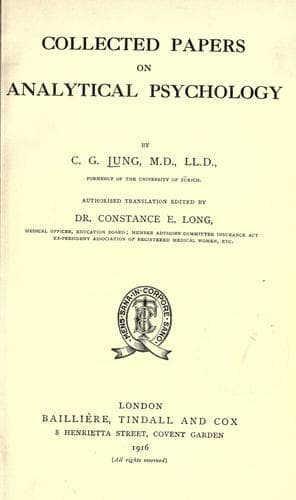
Collected Papers on Analytical PsychologyJung, C. G. (Carl Gustav)
Science
Collected Papers on Analytical Psychology
Jung, C. G. (Carl Gustav)
Psychoanalysis
Ladies and Gentlemen: In our last lecture we saw how important the
emotional processes of childhood are for later life. In to-day's lecture
I should like to give you some insight into the psychic life of the
child through the analysis of a four-year-old girl. It is much to be
regretted that there are few among you who have had the opportunity
of reading the analysis of "Little Hans" (_Kleiner Hans_), which was
published by Freud during the current year.[143] I ought to begin by
giving you the content of that analysis, so that you might be in a
position to compare Freud's results with those obtained by me, and
observe the marked, and astonishing similarity between the unconscious
creations of the two children. Without a knowledge of the fundamental
analysis of Freud, much in the report of the following case will
appear strange, incomprehensible, and perhaps unacceptable to you. I
beg you, however, to defer your final judgment and to enter upon the
consideration of these new subjects with a kindly disposition, for such
pioneer work in virgin soil requires not only the greatest patience on
the part of the investigator, but also the unprejudiced attention of
his audience. Because the Freudian investigations apparently involve a
discussion of the most intimate secrets of sexuality many people have
had a feeling of repulsion against them, and have therefore rejected
everything as a matter of course without any real disproof. This,
unfortunately, has almost always been the fate of Freud's doctrines up
to the present. One must not come to the consideration of these matters
with the firm conviction that they do not exist, for it may easily
happen that for the prejudiced they really do not exist. One should
perhaps assume the author's point of view for the moment and investigate
these phenomena under his guidance. Only in this way can the correctness
or otherwise of our observations be affirmed. We may err, as all human
beings err. But the continual holding up to us of our mistakes--perhaps
they are worse than mistakes--does not help us to see things more
distinctly. We should prefer to see _wherein_ we err. That should be
demonstrated to us in our own sphere of experience. Thus far, however,
no one has succeeded in meeting us on our own ground, nor in giving us a
different conception of the things which we ourselves see. We still have
to complain that our critics persist in maintaining complete ignorance
about the matters in question. The only reason for this is that they
have never taken the trouble to become thoroughly acquainted with our
method; had they done this they would have understood us.
Public-domain text, read in full here on John Shaqi.
Reviews
Reviews
No reviews yet
Be the first to share your thoughts on this work.
Elsewhere in the archive
Join the Discussion
Join the discussion
Sign in to leave a comment or review.
Sign InorCreate an account