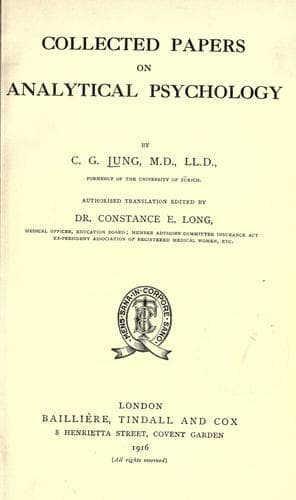
Collected Papers on Analytical PsychologyJung, C. G. (Carl Gustav)
Science
Collected Papers on Analytical Psychology
Jung, C. G. (Carl Gustav)
Psychoanalysis
But even before this question was settled as to where the child really
comes out a new problem obtruded itself, viz. the children came out
of the mother, but how is it with the nurse? Did some one come out of
her too? This question was followed by the remark, "No, no, the stork
brought down baby brother from heaven." What is there peculiar about the
fact that nobody came out of the nurse? We recall that Anna identified
herself with the nurse, and planned to become a nurse later, for she,
too, would like to have a child, and she could have one as well as the
nurse. But now when it is known that the little brother grew in mama,
how is it now?
This disquieting question is averted by a quick return to the
stork-angel theory which has never been really believed and which after
a few trials is at last definitely abandoned. Two questions, however,
remain in the air. The first reads as follows: Where does the child come
out? The second, a considerably more difficult one, reads: How does it
happen that mama has children while the nurse and the servants do not?
All these questions did not at first manifest themselves.
On the day following the explanation, while at dinner, Anna
spontaneously remarked: "My brother is in Italy, and has a house of
cloth and glass, but it does not tumble down."
In this case, as in the others, it was impossible to ask for an
explanation; the resistances were too great and Anna could not be drawn
into conversation. This former officious and pretty explanation is very
significant. For some three months the two sisters had been building
a stereotyped fanciful conception of a "big brother." This brother
knows everything, he can do and has everything, he has been and is in
every place where the children are not; he is owner of great cows,
oxen, horses, dogs; everything is his, etc. Every one has such a "big
brother." We must not look far for the origin of this fancy; the model
for it is the _father_ who seems to correspond to this conception;
he seems to be like a brother to mama. The children, too, have their
similar powerful "brother." This brother is very brave; he is at present
in dangerous Italy and inhabits an impossible fragile house, and _it
does not tumble down_. For the child this realises an important wish:
_the earthquake is no longer to be dangerous_; in consequence _the
child's fear disappeared and did not return_. The fear of earthquakes
now entirely vanished. Instead of calling her father to her bed to
conjure away the fear, she now became very affectionate and begged him
every night to kiss her.
Public-domain text, read in full here on John Shaqi.
Reviews
Reviews
No reviews yet
Be the first to share your thoughts on this work.
Elsewhere in the archive
Join the Discussion
Join the discussion
Sign in to leave a comment or review.
Sign InorCreate an account