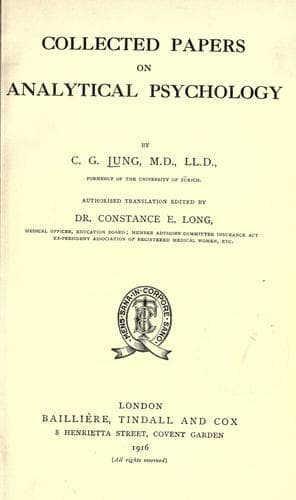
Collected Papers on Analytical PsychologyJung, C. G. (Carl Gustav)
Science
Collected Papers on Analytical Psychology
Jung, C. G. (Carl Gustav)
Psychoanalysis
Freud has pointed out in many places[150] with unmistakable clearness
that the psychosexual relationship of the child towards his parents,
particularly towards the father, possesses an overwhelming importance
in the content of any later neurosis. This relationship is in fact the
infantile channel _par excellence_ in which the libido flows back[151]
when it encounters any obstacles in later years, thus revivifying
long-forgotten dreams of childhood. It is ever so in life when we
draw back before too great an obstacle--the menace of some severe
disappointment or the risk of some too far-reaching decision--the
energy stored up for the solution of the task flows back impotent;
the by-streams once relinquished as inadequate are again filled up.
He who has missed the happiness of woman's love falls back, as a
substitute, upon some gushing friendship, upon masturbation, upon
religiosity; should he be a neurotic he plunges still further back into
the conditions of childhood which have never been quite forsaken, to
which even the normal is fettered by more than one link--he returns to
the relationship to father and mother. Every psychoanalysis carried
out at all thoroughly shows this regression more or less plainly. One
peculiarity which stands out in the works and views of Freud is that
the relationship to the father is seen to possess an overwhelming
importance. This importance of the father in the moulding of the
child's psycho-sexuality may also be discovered in a quite other and
remote field, in the investigation of the family.[152] The most recent
thorough investigations demonstrate the predominating influence of the
father often lasting for centuries. The mother seems of less importance
in the family.[153] If this is true for heredity on the physical side
how much more should we expect from the psychological influences
emanating from the father? These experiences, and those gained more
particularly in an analysis carried out conjointly with Dr. Otto Gross,
have impressed upon me the soundness of this view. The problem has been
considerably advanced and deepened by the investigations of my pupil,
Dr. Emma Fürst, into familial resemblances in the reaction-type.[154]
Fürst made association experiments on one hundred persons belonging
to twenty-four families. Of this extensive material, only the results
in nine families and thirty-seven persons (all uneducated) have been
worked out and published. But the painstaking calculations do already
permit some valuable conclusions. The associations are classified on the
KRÆPELIN-ASCHAFFENBURG scheme as simplified and modified by myself; the
difference is then calculated between each group of qualities of the
subjects experimented upon and the corresponding group of every other
subject experimented upon. Thus we finally get the differentiation of
the mean in reaction-type. The following is the result:--
Public-domain text, read in full here on John Shaqi.
Reviews
Reviews
No reviews yet
Be the first to share your thoughts on this work.
Elsewhere in the archive
Join the Discussion
Join the discussion
Sign in to leave a comment or review.
Sign InorCreate an account