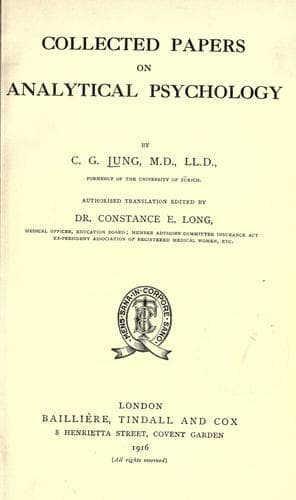
Collected Papers on Analytical PsychologyJung, C. G. (Carl Gustav)
Science
Collected Papers on Analytical Psychology
Jung, C. G. (Carl Gustav)
Psychoanalysis
The fact of the extreme similarity between the reaction-type of the
offspring and the parents is matter for thought. The association
experiment is nothing but a small section from the psychological life of
a man. At bottom daily life is nothing but an extensive and many-varied
association experiment; in essence we react in life just as we do in
the experiments. Although this truth is evident, still it requires
a certain consideration and limitation. Let us take as an instance
the case of the unhappy mother of forty-five years and her unmarried
daughter of sixteen. The extreme word-predicate type of the mother is,
without doubt, the precipitate of a whole life of disappointed hopes
and wishes. One is not in the least surprised at the word-predicate
type here. But the daughter of sixteen has really not yet lived at all;
her real sexual object has not yet been found, and yet she reacts as if
she were her mother with endless disillusions behind her. She has _the
mother's adaptation_, and in so far she is identified with the mother.
There is ample evidence that the mother's adaptation must be attributed
to her relationship to the father. But the daughter is not married to
the father and therefore does not need this adaptation. She has taken it
over from the influence of her milieu, and later on will try to adapt
herself to the world with this _familial disharmony_. In so far as an
ill-assorted marriage is unsuitable, the adaptation resulting from it is
unsuitable.
Clearly such a fate has many possibilities. To adapt herself to life,
this girl either will have to surmount the obstacles of her familial
milieu, or, unable to free herself from them, she _will succumb to
the fate to which such an adaptation predisposes_ her. Deep within,
unnoticed by any one, there may go on a glossing over of the infantile
disharmony, or a development of the negative of the parents' character,
accompanied by hindrances and conflicts to which she herself has no
clue. Or, growing up, she will come into painful conflict with that
world of actualities to which she is so ill-adapted till one stroke
of fate after another gradually opens her eyes to the fact that it
is herself, infantile and maladjusted, that is amiss. The source
of infantile adaptation to the parents is naturally the affective
condition on both sides; the psycho-sexuality of the parents on one side
and that of the child on the other. It is a kind of psychical infection;
we know that it is not logical truth, but affects and their psychical
expressions[156] which are here the effective forces. It is these that,
with the power of the herd-instinct, press into the mind of the child,
there fashioning and moulding it. In the plastic years between one and
five there have to be worked out all the essential formative lines which
fit exactly into the parental mould. Psychoanalytic experience teaches
us that, as a rule, the first signs of the later conflict between the
Public-domain text, read in full here on John Shaqi.
Reviews
Reviews
No reviews yet
Be the first to share your thoughts on this work.
Elsewhere in the archive
Join the Discussion
Join the discussion
Sign in to leave a comment or review.
Sign InorCreate an account