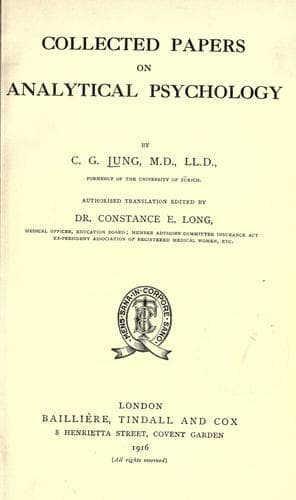
Collected Papers on Analytical PsychologyJung, C. G. (Carl Gustav)
Science
Collected Papers on Analytical Psychology
Jung, C. G. (Carl Gustav)
Psychoanalysis
After this recital she broke out into a whole series of lamentations:
she must separate from her husband: she would have done it long ago if
it were not for the children. She had indeed done an ill-deed, committed
a very great sin when she married her husband against her father's wish.
She ought to have taken the man whom her father had wanted her to have.
He certainly would have obeyed her father and then everything would have
been right. Oh, her husband was not by a long way so kind as her father,
she could do anything with her father, but not with her husband. Her
father had given her everything she wanted. _Now she would best of all
like to die, so that she might be with her father._
When this outburst was over, I inquired eagerly on what grounds she had
refused the husband her father had suggested to her.
The father, a small peasant on a lean little farm, had taken as a
servant, just at the time when his youngest daughter came into the
world, a miserable little boy, a foundling. The boy developed in most
unpleasant fashion: he was so stupid that he could not learn to read
or write or even speak quite properly. He was an absolute idiot. As he
approached manhood there developed on his neck a series of ulcers, some
of which opened and continually discharged pus, giving such a dirty,
ugly creature a horrible appearance. His intelligence did not grow with
his years, so he stayed on as servant in the peasant's house without any
recognised wage.
_To this youth the father wanted to marry his favourite daughter._
The girl, fortunately, had not been disposed to yield, but now she
regretted it, since this idiot would unquestionably have been more
obedient to her father than her good man had been.
Here, as in the foregoing case, it must be clearly understood that the
patient is not at all weak-minded. Both possess normal intelligence,
which unfortunately the blinkers of the infantile constellation prevent
their using. That appears with quite remarkable clearness in this
patient's life-story. The father's authority is never questioned! It
makes not the least difference that he is a quarrelsome drunkard, the
obvious cause of all the quarrels and disturbances; on the contrary, the
lawful husband must give way to the bogey, and at last our patient even
comes to regret that her father did not succeed in completely destroying
her life's happiness. So now she sets about doing that herself through
her neurosis, which compels in her the wish to die, that she may go to
hell, whither, be it noted, the father has already betaken himself.
Public-domain text, read in full here on John Shaqi.
Reviews
Reviews
No reviews yet
Be the first to share your thoughts on this work.
Elsewhere in the archive
Join the Discussion
Join the discussion
Sign in to leave a comment or review.
Sign InorCreate an account