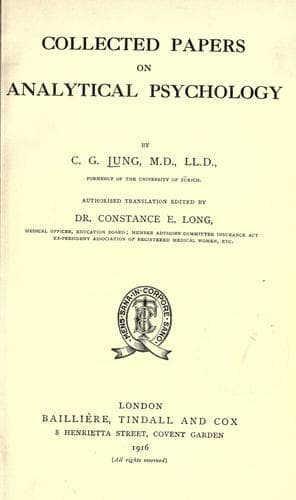
Collected Papers on Analytical PsychologyJung, C. G. (Carl Gustav)
Science
Collected Papers on Analytical Psychology
Jung, C. G. (Carl Gustav)
Psychoanalysis
Before turning our attention to this, let us cast a glance at the
dream analytically. In the first place, we must accept the facts and
agree with the teacher that we have to do with a dream and not with
an invention; for the latter the ambiguity is too great. Conscious
invention tries to create unbroken transitions; the dream takes no
account of this, but sets to work regardless of gaps, which, as we
have seen, here give occasion for interpolations during the conscious
revision. The gaps are very significant. In the swimming-bath there is
no picture of undressing, being unclothed, nor any detailed description
of their being together in the water. The omission of being dressed
on the ship is compensated for by the above-mentioned interpolation,
but only for the teacher, thus indicating that his nakedness was in
most urgent need of cover. The detailed description of the wedding
is wanting, and the transition from the steamer to the wedding is
abrupt. The reason for stopping overnight in the barn at Andermatt is
not to be found at first. The parallel to this is, however, the want
of room in the swimming-bath, which made it necessary to go into the
men's department; in the hotel the want of room again emphasises the
separation of the sexes. The picture of the barn is most insufficiently
filled out. The birth suddenly follows and quite without sequence.
The teacher as godfather is extremely equivocal. Marie's rôle in the
whole story is throughout of secondary importance, indeed she is only a
spectator.
All this has the appearance of a genuine dream, and those of my readers
who have a wide experience of the dreams of girls of this age will
assuredly confirm this view. Hence the meaning of the dream is so simple
that we may quietly leave its interpretation to her school-companions,
whose declarations are as follows:
AURAL WITNESSES.
_Witness I._--"M. dreamed that she and Lina P. had gone swimming with
our teacher. After they had swum out in the lake pretty far, M. said she
could not swim any further as her foot hurt her so much. The teacher
said she might sit on my[162] back. M. got up and they swam out. After a
time a steamer came along and they got up on it. Our teacher seems to
have had a rope by which he tied M. and L. together and dragged them out
into the lake. They travelled thus as far as Z., where they stepped out.
But now they had no clothes on. The teacher bought a jacket whilst M.
and L. got a long, thick veil, and all three walked up the street along
the lake. This was when the wedding was going on. Presently they met the
party. The bride had on a blue silk dress but no veil. She asked M. and
L. if they would be kind enough to give her their veil. M. and L. gave
it, and in return they were allowed to go to the wedding. They went into
the Sun Inn. Afterwards they went a honeymoon journey to Andermatt; I do
not know now whether they went to the Inn at A. or at Z. There they got
coffee, potatoes, honey, and butter."
Public-domain text, read in full here on John Shaqi.
Reviews
Reviews
No reviews yet
Be the first to share your thoughts on this work.
Elsewhere in the archive
Join the Discussion
Join the discussion
Sign in to leave a comment or review.
Sign InorCreate an account