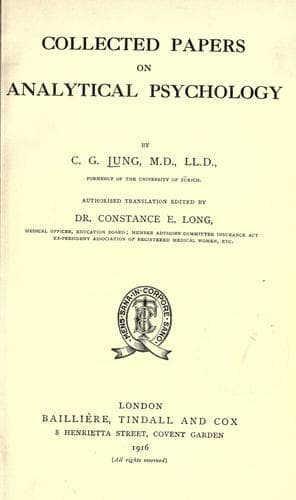
Collected Papers on Analytical PsychologyJung, C. G. (Carl Gustav)
Science
Collected Papers on Analytical Psychology
Jung, C. G. (Carl Gustav)
Psychoanalysis
_Witness II._--M. dreamt she had gone bathing with L. P. and the
teacher. Far out in the lake M. said to the teacher that her leg was
hurting her very much. Then the teacher said she could get up on him.
I don't know now whether the last sentence was really so told, but I
think so. As there was just then a ship on the lake the teacher said
she should swim as far as the ship and then get in. I don't remember
exactly how it went on. Then the teacher or M., I don't really remember
which, said they would get out at Z. and run home. Then the teacher
called out to two gentlemen who had just been bathing there, that they
might carry the children to land. Then L. P. sat up on one man, and M.
on the other fat man, and the teacher held on to the fat man's leg and
swam after them. Arrived on land they ran home. On the way the teacher
met his friend who had a wedding. M. said: "It was then the fashion to
go on foot, not in a carriage." Then the bride said she must now go
along also. Then the teacher said it would be nice if the two girls gave
the bride their black veils, which they had got on the way. I can't now
remember how. The children gave it her, and the bride said they were
really dear generous children. Then they went on further and put up at
the Sun Hotel. There they got something to eat, I don't know exactly
what. Then they went to a barn and danced. All the men had taken off
their coats except the teacher. Then the bride said he ought to take off
his coat also. Then the teacher hesitated but finally did so. Then the
teacher was.... Then the teacher said he was cold. I must not tell any
more; it is improper. That's all I heard of the dream.
_Remarks._--The narrator pays special attention to the getting up, but
is uncertain whether in the original it referred to getting up on the
teacher or the steamer. This uncertainty is, however, amply compensated
for by the elaborate invention of the two strangers who take the girls
upon their backs. The getting up is too valuable a thought for the
narrator to surrender, but she is troubled by the idea of the teacher
seeing the object. The want of clothing likewise arouses much interest.
The bride's veil has, it is true, become the black veil of mourning
(naturally in order to conceal anything indelicate). There is not only
no innocent twisting, but it is conspicuously virtuous ("dear, generous
children"); the amoral wish has become changed into virtue which
receives special emphasis, arousing suspicion as does every accentuated
virtue.
This narrator exuberantly fills in the blanks in the scene of the barn:
the men take off their coats; the teacher also, and is therefore ...
_i.e._ naked and hence cold. Whereupon it becomes too improper.
Public-domain text, read in full here on John Shaqi.
Reviews
Reviews
No reviews yet
Be the first to share your thoughts on this work.
Elsewhere in the archive
Join the Discussion
Join the discussion
Sign in to leave a comment or review.
Sign InorCreate an account