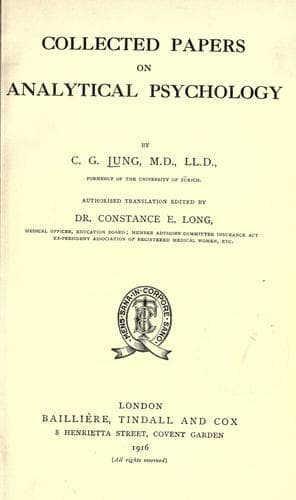
Collected Papers on Analytical PsychologyJung, C. G. (Carl Gustav)
Science
Collected Papers on Analytical Psychology
Jung, C. G. (Carl Gustav)
Psychoanalysis
Now I have analysed this with the aid of the following process of
reasoning: If I say that the stairs are a symbol for the sexual act,
whence do I obtain the right to regard the mother, the sister, and the
child as concrete; that is, as not symbolic? If, on the strength of
the claim that dream pictures are symbolic, I give to certain of these
pictures the value of symbols, what right have I to exempt certain other
dream parts from this process? If, therefore, I attach symbolic value
to the ascent of the stairs, I must also attach a symbolic value to the
pictures that represent the mother, the sister, and the child. Therefore
I did not translate the dream, but really analysed it. The result was
surprising. I will give you the free associations with the separate
dream-parts, word for word, so that you can form your own opinions
concerning the material. I should state in advance that the young man
had finished his studies at the university a few months previously; that
he found the choice of a profession too difficult to make; and that he
thereupon became a neurotic. In consequence of this he gave up his work.
His neurosis took, among other things, a decidedly homosexual form.
The patient's associations with his mother are as follows: "I have not
seen her for a long time, a very long time. I really ought to reproach
myself for this. It is wrong of me to neglect her so." "Mother," then,
stands here for something which is neglected in an inexcusable manner. I
said to the patient: "What is that?" And he replied, with considerable
embarrassment, "My work."
With his sister he associated as follows: "It is years since I have seen
her. I long to see her again. Whenever I think of her I recall the time
when I took leave of her. I kissed her with real affection; and at that
moment I understood for the first time what love for a woman can mean."
It is at once clear to the patient that his sister represents "love for
woman."
With the stairs he has this association: "Climbing upwards; getting to
the top; making a success of life; being grown up; being great." The
child brings him the ideas: "New born; a revival; a regeneration; to
become a new man."
One only has to hear this material in order to understand at once that
the patient's dream is not so much the fulfilment of infantile desires,
as it is the expression of biological duties which he has hitherto
neglected because of his infantilism. Biological justice, which is
inexorable, sometimes compels the human being to atone in his dreams for
the duties which he has neglected in real life.
Public-domain text, read in full here on John Shaqi.
Reviews
Reviews
No reviews yet
Be the first to share your thoughts on this work.
Elsewhere in the archive
Join the Discussion
Join the discussion
Sign in to leave a comment or review.
Sign InorCreate an account