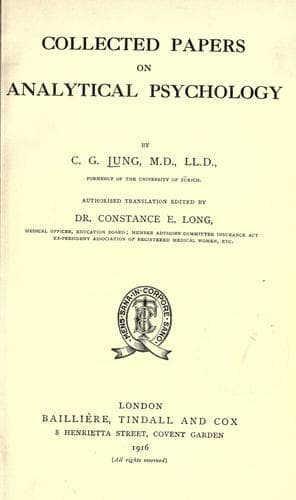
Collected Papers on Analytical PsychologyJung, C. G. (Carl Gustav)
Science
Collected Papers on Analytical Psychology
Jung, C. G. (Carl Gustav)
Psychoanalysis
You ask me, or indeed tell me--what psychoanalysis is. Before
considering your views, permit me first to try and mark out the
territory and definition of psychoanalysis. Psychoanalysis is primarily
just a method--but a method complying with all the rigorous demands
insisted upon to-day by the conception "method." Let it be made plain
at once that psychoanalysis is not an _anamnesis_, as those who know
everything without learning are pleased to believe. It is essentially
a method for the exploration of the unconscious associations, into
which no question of the conscious self enters. Again, it is not
a _kind_ of _examination_ of the nature of an intelligence test,
though this mistake is common in certain circles. It is no _cathartic
method_, abreacting real and phantastic "traumata," with or without
hypnosis. _Psychoanalysis is a method which makes possible the analytic
reduction of the psychic content to its simplest expression, and the
discovery of the line of least resistance in the development of a
harmonious personality._ In neurosis, straightforward direction of
life's energies is lacking, because opposing tendencies traverse and
hinder psychological adaptation. Psychoanalysis, so far as our present
knowledge of it goes, thus appears to be simply a rational nerve-therapy.
For the technical application of psychoanalysis no programme can be
formulated. There are only general principles, and, for the individual
case, working rules. (Here let me refer you to Freud's work in volume
I. of the _Internationale Zeitschrift für Ärztliche Psychoanalyse_.) My
one working rule is to conduct the analysis as a perfectly ordinary,
sensible conversation, and to avoid all appearance of medical magic.
The leading principle of the psychoanalytic technique is to analyse
the _psychic material which offers itself then and there_. Every
interference on the part of the analyst, with the object of inducing
the analysis to follow some systematic course, is a gross mistake in
technique. _So-called chance is the law and the order of psychoanalysis._
Naturally in the beginning of the analysis the anamnesis and the
diagnosis come first. The subsequent analytic process develops quite
differently in every case. To give rules is well-nigh impossible. All
one can say is that very frequently, quite at the beginning, a series
of resistances have to be overcome, resistances against both method and
man. Patients having no idea of psychoanalysis must first be given some
understanding of the method. In those who already know something of it
there are very often many misconceptions to set right, and frequently
one has to deal also with many reproaches cast by scientific criticism.
In either case the misconceptions rest upon arbitrary interpretations,
superficiality, or complete ignorance of the facts.
Public-domain text, read in full here on John Shaqi.
Reviews
Reviews
No reviews yet
Be the first to share your thoughts on this work.
Elsewhere in the archive
Join the Discussion
Join the discussion
Sign in to leave a comment or review.
Sign InorCreate an account