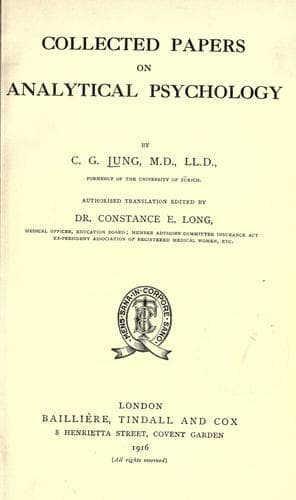
Collected Papers on Analytical PsychologyJung, C. G. (Carl Gustav)
Science
Collected Papers on Analytical Psychology
Jung, C. G. (Carl Gustav)
Psychoanalysis
Upon reviewing this material we see that the dream contains a very
transparent reference to the last-named incident. The connecting
associative material shows that the apple episode is palpably meant for
an erotic scene. For various other reasons, too, it may be considered
extremely probable that this experience of the previous day is operative
even in this dream. In the dream the young man plucks the apple of
Paradise, which in reality he has not yet plucked. The remainder of the
material associated with the dream is concerned with another experience
of the previous day, namely, with the peculiar feeling of a _bad
conscience_, which seized the dreamer when he was talking to his casual
lady acquaintance; this, again, was connected with the fall of man in
Paradise, and finally with an erotic misdemeanour of his childhood, for
which his father had punished him severely. All these associations are
linked together by the idea of _guilt_.
In the first place we will consider this material from Freud's
view-point of causality; in other words, we will "interpret" it, to use
Freud's expression. A wish has been left unfulfilled from the day before
the dream. In the dream this wish is realised in the _symbolical_ apple
scene. But why is this realisation disguised and hidden under a symbolic
image instead of being expressed in a distinctly sexual thought? Freud
would refer to the unmistakable sense of guilt shown up by the material,
and say the morality that has been inculcated in the young man from
childhood is bent on repressing such wishes, and to that end brands the
natural craving as immoral and reprehensible. The suppressed immoral
thought can therefore only achieve expression by means of a _symbol_. As
these thoughts are incompatible with the moral content of the conscious
ego, a psychic factor adopted by Freud called the _Censor_, prevents
this wish from passing undisguised into consciousness.
Reviewing the dream from the standpoint of finality, which I contrast
with that of Freud, does not--as I wish to establish explicitly--involve
a denial of the dream's _causæ_, but rather a different interpretation
of the associative material collected around the dream. The material
facts remain the same, but the standard by which they are measured is
altered. The question may be formulated simply as follows: What is
this dream's purpose? What should it effect? These questions are not
arbitrary, in as much as they may be applied to every psychic activity.
Everywhere the question of the "why" and "wherefore" may be raised.
Public-domain text, read in full here on John Shaqi.
Reviews
Reviews
No reviews yet
Be the first to share your thoughts on this work.
Elsewhere in the archive
Join the Discussion
Join the discussion
Sign in to leave a comment or review.
Sign InorCreate an account