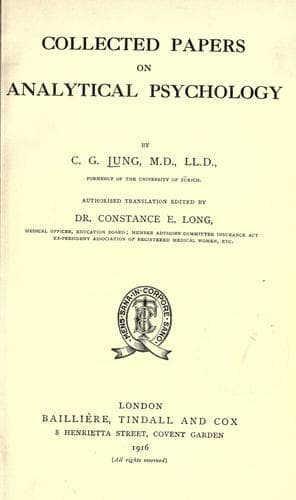
Collected Papers on Analytical PsychologyJung, C. G. (Carl Gustav)
Science
Collected Papers on Analytical Psychology
Jung, C. G. (Carl Gustav)
Psychoanalysis
The older asylum physicians paid great attention to the psychological
precursors of mental disorder, just as the public still does, following
a true instinct. We accepted this hint and carefully investigated the
previous psychological history wherever possible. Our trouble was richly
rewarded, for we often found, to our surprise, that the disease broke
out at a moment of some great emotion which, in its turn, had arisen in
a so-called normal way. We found, moreover, that in the mental disease
which ensued a number of symptoms occurred which it was quite labour in
vain to study from the morphological standpoint. These same symptoms,
however, were comprehensible when considered from the standpoint of the
individual's previous history. Freud's fundamental investigations into
the psychology of hysteria and dreams afforded us the greatest stimulus
and help in our work.
A few instances of the latest method in psychiatry will make the
subject clearer than mere dry theory. In order to bring home to you the
difference in our conception I will first describe the medical history
in the older fashion, and subsequently give the solution characteristic
of the new departure.
The case to be considered is that of a cook aged 32; she had no
hereditary taint, was always industrious and conscientious, and had
never been noticeable for eccentric behaviour or the like. Quite
recently she became acquainted with a young man whom she wished to
marry. From that time on she began to show certain peculiarities. She
often spoke of his not liking her much, was frequently out of sorts,
ill-tempered, and sat alone brooding; once she ornamented her Sunday hat
very strikingly with red and green feathers, another day she bought a
pair of pince-nez in order to wear them when she went out walking with
her fiancé. One day the sudden idea that her teeth were rather ugly
would not let her rest, and she resolved to get a plate, although there
was no absolute need. She had all her teeth out under an anæsthetic. The
night after the operation she suddenly had a severe anxiety-attack. She
cried and moaned that she was damned for ever, for she had committed
a great sin; she should not have allowed her teeth to be extracted.
People must pray for her, that God might pardon her sin. In vain her
friends attempted to talk her out of her fears, to assure her that the
extraction of teeth was really no sin; it availed nothing. At day-break
she became somewhat quieter; she worked throughout the day. On following
nights the attacks were repeated. When consulted by the patient I found
her quiet, but she wore a rather vacant expression. I talked to her
about the operation, and she assured me it was not so dreadful to have
teeth extracted, but still it was a great sin, from which position,
despite every persuasion, she could not be moved. She continually
repeated in plaintive, pathetic tones, "I should not have allowed my
teeth to be extracted; oh yes, that was a great sin which God will never
Public-domain text, read in full here on John Shaqi.
Reviews
Reviews
No reviews yet
Be the first to share your thoughts on this work.
Elsewhere in the archive
Join the Discussion
Join the discussion
Sign in to leave a comment or review.
Sign InorCreate an account