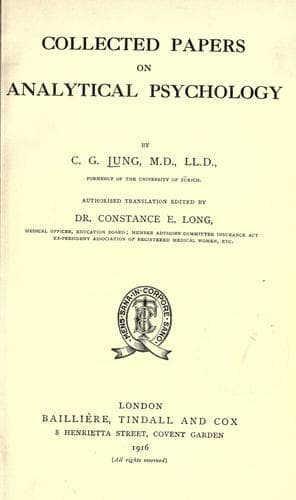
Collected Papers on Analytical PsychologyJung, C. G. (Carl Gustav)
Science
Collected Papers on Analytical Psychology
Jung, C. G. (Carl Gustav)
Psychoanalysis
Our patient here portrayed but a pale copy of the scene in the first
attack of psychosis, when he, the victor, stood before his mistress.
In the course of a few weeks after this conversation the scientific
interests of the patient again began to predominate. He spoke with
obvious unwillingness about his intimate life, he repressed it more
and more, and finally turned away from it as if it did not belong to
himself. Thus gradually the gate of the under-world became closed.
There remained nothing but a certain tense expression, and a look
which, though fixed on the outer world, was turned inwards at the same
time; and this alone hinted at the silent activity of the unconscious,
preparing new solutions for his insoluble problem. This is the so-called
cure in dementia præcox.
Hitherto we psychiatrists used not to be able to suppress a laugh when
we read an artist's attempts to portray a psychosis. These attempts have
been generally regarded as quite useless, for the writer introduces
into his conception of the psychosis psychological relationships quite
foreign to the clinical picture of the disease. But the artist has not
simply proceeded to copy a case out of a psychiatric text-book; he knows
as a rule better than the psychiatrist.
The case which I have sketched is not unique, it is typical of a whole
class for which the artist Spitteler has created a model of universal
validity; the model is _Imago_. I may take for granted that you know his
book of that name. The psychological gulf, however, between the creation
of the artist and the insane person is great. The world of the artist
is one of solved problems; the world of reality, that of unsolved
problems. The mental patient is a faithful image of this reality. His
solutions are unsatisfying illusions, his cure a temporary giving up of
the problem, which yet goes on working in the depths of the unconscious,
and at the appointed time again rises to the surface and creates new
illusions with new scenery; part of the history of mankind is here seen
abridged.
Public-domain text, read in full here on John Shaqi.
Reviews
Reviews
No reviews yet
Be the first to share your thoughts on this work.
Elsewhere in the archive
Join the Discussion
Join the discussion
Sign in to leave a comment or review.
Sign InorCreate an account