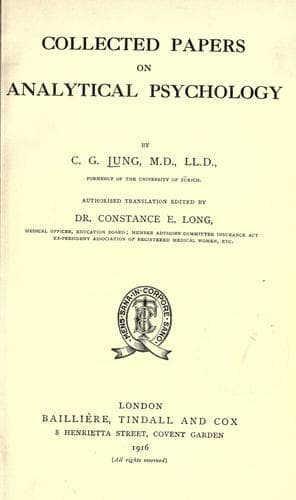
Collected Papers on Analytical PsychologyJung, C. G. (Carl Gustav)
Science
Collected Papers on Analytical Psychology
Jung, C. G. (Carl Gustav)
Psychoanalysis
We had a patient who was for thirty-five years an inmate at Burghölzli.
For decades she lay in bed, she never spoke or reacted to anything, her
head was always bowed, her back bent and the knees somewhat drawn up.
She was always making peculiar rubbing movements with her hands, so as
to give rise during the course of years to thick horny patches on her
hands. She kept the thumb and index finger of her right hand together
as in the movement of sewing. When she died I tried to discover what
she had been formerly. Nobody in the asylum recalled ever having seen
her out of bed. Only our chief attendant had a memory of having seen
her sitting in the same attitude as that she afterwards took up in bed,
at which time she was making rapid movements of extension of the arm
across the right knee; it was said of her that she was sewing shoes,
later that she was polishing shoes. As time went on the movements became
more limited till finally there remained but a slight rubbing movement,
and only the finger and thumb retained the sewing position. In vain
I consulted our old attendant, she knew nothing about the patient's
previous history. When the seventy-year-old brother came to the funeral
I asked him what had been the cause of his sister's illness; he told
me that she had had a love-affair, but for various reasons it had
come to nothing. The girl had taken this so to heart that she became
low-spirited. In answer to a query about her lover it was found that he
was a _shoemaker_.
Unless you see here some strange play of accident, you must agree that
the patient had kept the memory-picture of her lover unaltered in her
heart for thirty-five years.
One might easily think that these patients who give an impression of
imbecility are only burnt-out ruins of humanity. But such is probably
not the case. One can often prove directly that such patients register
everything going on around them even with a certain curiosity, and have
an excellent memory for it all. This is the reason why many patients
become for a time pretty sensible again, and develop mental powers which
one believed they had long since lost. Such intervals occur occasionally
during serious physical disease, or just before death. We had a patient
with whom it was impossible to carry on a sane conversation; he only
produced a mad medley of delusions and words. He once fell seriously
ill physically, and I expected it would be very difficult to treat him.
Not at all. He was quite changed, he became friendly and amiable, and
carried out all his doctor's orders patiently and gratefully. His eyes
lost their evil darting looks, and shone quietly and understandingly.
One morning I came to his room with the usual greeting: "Good morning.
How are you getting on?" The patient answered me in the well-known way:
"There again comes one of the dog and monkey troupe wanting to play the
Saviour." Then I knew his physical trouble was over. From that moment
the whole of his reason was as if "blown away" again.
Public-domain text, read in full here on John Shaqi.
Reviews
Reviews
No reviews yet
Be the first to share your thoughts on this work.
Elsewhere in the archive
Join the Discussion
Join the discussion
Sign in to leave a comment or review.
Sign InorCreate an account